Market Fundamentals: A New Era
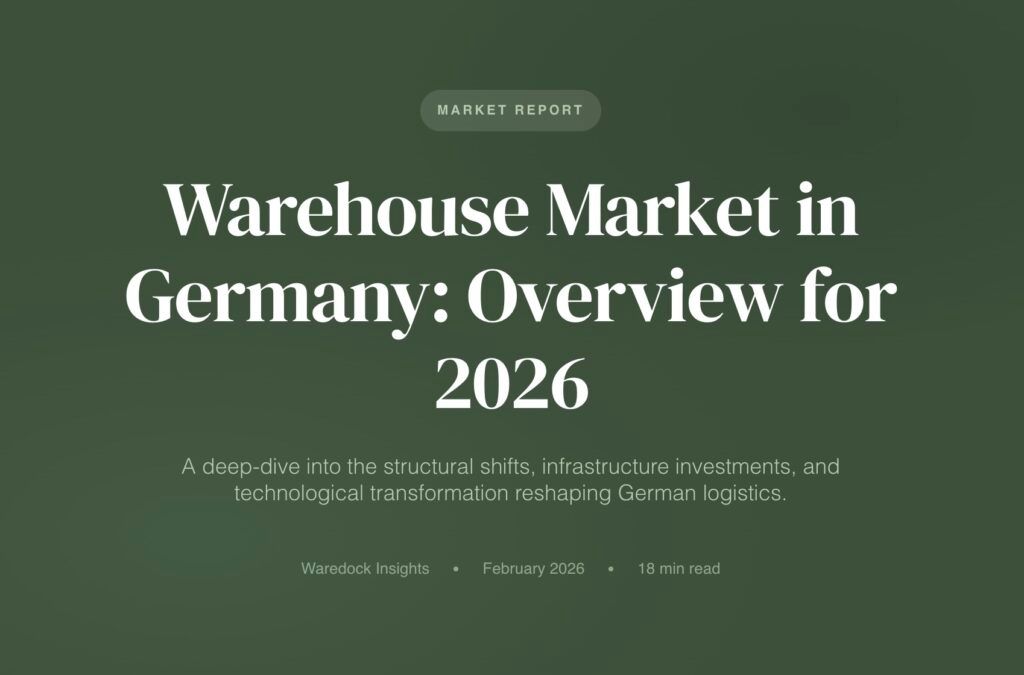
The fundamental drivers of the German logistics market have expanded beyond traditional e-commerce and retail tailwinds. In 2026, new structural catalysts have emerged as primary market drivers, most notably the rapid expansion of the defense sector and the complex logistical requirements of the electric vehicle battery supply chain. The ongoing trend of nearshoring—relocating manufacturing closer to European consumer markets—is generating sustained demand for large-scale distribution centers and specialized manufacturing facilities.
While the broader German economy experiences gradual recovery with projected real GDP growth of approximately 1.1% to 1.2%, the logistics sector continues to outperform other commercial asset classes. Prime yields across the "Big 5" hubs (Berlin, Frankfurt, Munich, Hamburg, and Rhine-Ruhr) have stabilized at approximately 4.5%, with inward pressure anticipated throughout 2026 as competition for best-in-class assets intensifies.
1.1%
Real GDP Growth (2026)
4.5%
Prime Yields (Big 5 Hubs)
€228B
Logistics Market Size
87%
E-commerce Penetration
Macroeconomic Framework
The economic environment in Germany in 2026 is defined by moderate stabilization at a low growth level. After a challenging 2024 and 2025, the economy is supported principally by government spending and gradual acceleration in exports. Inflation has moderated significantly, with the Eurozone average expected to hit 1.5% in 2026, providing a more stable backdrop for long-term real estate underwriting.
| Economic Indicator | 2026 Projection | Historical Context |
|---|---|---|
| Real GDP Growth | 1.1% | 1.2% (10-yr average) |
| Inflation Rate | 1.5% | 1.7% (10-yr average) |
| Unemployment Rate | 6.3% | 5.8% (10-yr average) |
| Household Growth | 0.4% | 0.3% (10-yr average) |
| Logistics Market Size | $227.99 Billion | $221.37 Billion (2025) |
Despite the lower inflation environment, the European Central Bank is not expected to pursue aggressive rate cuts in 2026, maintaining a cautious stance to ensure price stability. This "higher-for-longer" interest rate environment has fundamentally changed how real estate is priced and financed.
Scale Your Business with Waredock
Waredock provides ecommerce fulfillment services from Germany and the Czech Republic, offering competitive rates and strategic access to Central European markets. Our AI-first logistics platform enables seamless fulfillment across a distributed 3PL network.
Get StartedCapital Markets: The Return of Liquidity
The German investment market for commercial real estate gained significant momentum in the final quarter of 2025, a trend that has solidified in 2026. Total transaction volumes in 2025 reached approximately €23.04 billion, representing a 3% increase over the previous year, with the fourth quarter alone contributing €6.95 billion.
Logistics remains one of the most sought-after asset classes, frequently ranking as the second-most popular sector behind residential property. International capital, particularly from Asia and North America, accounts for approximately 45% of the total transaction volume, highlighting Germany's enduring appeal as a defensive safe haven within Europe.
Yield Stability and Compression Potential
| Logistics Hub | Prime Yield (Q1 2026) | Trend |
|---|---|---|
| Berlin | 4.50% | Stable/Compression |
| Düsseldorf | 4.50% | Stable |
| Frankfurt | 4.50% | Stable/Compression |
| Hamburg | 4.50% | Stable |
| Munich | 4.50% | Stable/Compression |
Market Bifurcation: There is a widening divergence between prime and secondary assets. While top-tier warehouses in prime locations are seeing yields compress due to scarcity and high demand, secondary asset yields remain flat or continue to soften. This bifurcation is driven by a flight to quality, as investors prioritize assets that are ESG-compliant and equipped for modern automation.
Demand Drivers: Beyond E-commerce
The Defense Industry: A New Structural Pillar
Perhaps the most significant development in 2026 is the emergence of the defense sector as a primary driver of industrial and logistics demand. Driven by increased public defense spending and a focus on domestic production, defense companies are securing large-scale facilities for manufacturing, R&D, and secure logistics.
Rheinmetall, for instance, is constructing new artillery shell plants in Lower Saxony, estimated to catalyze a need for over 500,000 square meters of auxiliary space by 2030. The defense sector often seeks locations away from major cities but close to motorways, offering investors access to long-term leases (often 20 years) and tenants with excellent state-backed creditworthiness.
E-commerce and Last-Mile Delivery
E-commerce penetration continues to grow, with approximately 87% of German residents now shopping online. This has sustained a robust last-mile network, with parcel density reaching over 54 items per capita. E-commerce is expected to require an additional 650,000 square meters of space in 2026 alone, as major players like Amazon Fresh and REWE expand their delivery capabilities.
Nearshoring and Manufacturing Relocation
The nearshoring trend—relocating manufacturing closer to home markets to avoid global supply chain disruptions—is becoming a core execution issue in 2026. Shorter transit distances allow for better operational control and faster responsiveness to market shifts. German companies are increasingly moving production from distant continents to neighboring European countries or back to Germany itself.
| Sector | Demand Driver | Strategic Impact |
|---|---|---|
| Defense | High public spending | Long-term leases, rural hubs |
| E-commerce | 87% penetration | Last-mile hub expansion |
| EV Batteries | Automotive shift | Specialized "Hazmat" facilities |
| Nearshoring | Supply chain resilience | Central/Eastern European hubs |
Companies looking to capitalize on nearshoring opportunities can leverage Waredock's strategic fulfillment network. With locations in both Germany and the Czech Republic, Waredock offers cost-effective access to Central European markets while maintaining German quality standards and logistics excellence.
Regional Analysis: The Top 8 Hubs
Germany's logistics market is decentralized, with several major hubs each serving different strategic functions. In 2026, demand is concentrated in the Ruhr, Rhine-Main, and Munich regions, with continued high activity in Berlin-Brandenburg.
Munich: The High-Cost Benchmark
Munich remains the most expensive logistics market in Germany, with prime rents reaching €10.90 per square meter. The market is characterized by severe supply shortage and lack of available development land, keeping vacancy rates extremely low. Demand is driven by high-tech manufacturing and pharmaceuticals.
Frankfurt/Rhine-Main: The Multimodal Nexus
Frankfurt benefits from its central location and the presence of Europe's largest cargo hub at Frankfurt Airport. Prime rents have risen to €8.85 per square meter, a 4% increase year-over-year. The region is a favorite for financial services and data centers.
The Ruhr Region: Germany's Largest Consumer Market
The Ruhr region, including Dortmund and Duisburg (home to the world's largest inland port), is a dominant hub for 3PLs and retail distribution. Prime rents here have reached €7.90 per square meter, representing a 4% increase as demand for proximity to North Rhine-Westphalia's massive consumer base intensifies.
| Market | Prime Rent (€/sqm) | Average Rent (€/sqm) | Rent Trend |
|---|---|---|---|
| Munich | 10.90 | 9.00 | +1% |
| Frankfurt | 8.85 | 7.00 | +4% |
| Düsseldorf | 8.25 | 6.90 | +3% |
| Berlin | 8.20 - 8.70 | 7.20 | Stable |
| Hamburg | 8.10 | 6.50 | +1% |
| Ruhr Region | 7.90 | 6.50 | +4% |
| Cologne | 7.70 | 6.30 | Stable |
| Leipzig | 5.70 - 5.80 | 5.10 | Stable |
Sustainability: The 2026 Solar Standard
The regulatory environment for German warehouses is undergoing a major shift in 2026 with the implementation of the EU Solar Standard. Under the revised Energy Performance of Buildings Directive (EPBD), solar energy integration is no longer optional for new constructions.
Key Deadlines for Solar Installation
| Target Building Type | Deadline | Requirement |
|---|---|---|
| New Commercial/Public (>250sqm) | 2026 | Mandatory Installation |
| Public/Commercial Renovations | 2027 | Mandatory Solar |
| New Residential Buildings | 2029 | Mandatory Solar |
| Existing Public Buildings | 2030 | Mandatory Retrofit |
Sustainability has moved from a strategic priority to a core execution requirement. Most new builds now expect BREEAM or DGNB certification, with eaves heights of 10-12 meters regarded as crucial for both energy efficiency and automation compatibility.
Energy as a Location Factor: Energy supply is becoming a critical location factor. The electrification of truck fleets and the power-hungry nature of automated warehouses are pushing existing electricity grids to their capacity. Rapid network expansion and self-sufficient off-grid solutions (such as rooftop solar and local storage) are essential for logistics locations to remain competitive.
Technology and Automation
Germany faces a chronic labor shortage, with an estimated shortfall of 210,000 workers in the logistics sector. This deficit is prompting a massive wave of investment in warehouse automation, with the market for smart warehousing solutions projected to reach €6 billion.
AI-Driven Robotics and Efficiency Gains
In 2026, AI-powered systems have moved beyond pilot phases to become standard equipment in major fulfillment centers. These systems can increase order picking accuracy to 99.9%, significantly boosting productivity and reducing operational costs. Large retailers have achieved 30% reductions in operational costs and 25% increases in order fulfillment speed through implementation of AI-driven warehouse management and autonomous mobile robots.
99.9%
Order Picking Accuracy
30%
Cost Reduction Potential
25%
Fulfillment Speed Increase
€6B
Smart Warehousing Market
Key Technologies
Autonomous Mobile Robots (AMRs): Used for picking, packing, and repetitive lifting tasks, AMRs are becoming standard in modern warehouses.
IoT Sensors: Providing real-time visibility into inventory location and condition, enabling proactive management and reducing losses.
Predictive Analytics: Helping businesses pinpoint peak seasons and determine optimal staffing levels, reducing waste and improving service levels.
Robotics-as-a-Service (RaaS): Gaining traction among 3PLs with shorter contract durations, allowing for modular and flexible automation without high upfront capital expenditure.
Labor Market and Immigration Policy
The German labor market in 2026 remains a study in contradictions. While the general unemployment rate has risen slightly to 2.908 million people, the skilled worker shortage continues to weigh heavily on 163 occupations. Transport and logistics are among the hardest-hit sectors.
EU Blue Card for Shortage Occupations
To combat labor bottlenecks, Germany has eased immigration policies for "shortage occupations" (Mangelberufe). For the logistics sector, this allows international professionals to qualify for the EU Blue Card with a lower minimum gross annual salary.
| EU Blue Card Criteria 2026 | Requirement |
|---|---|
| Minimum Salary (Annual) | €45,934.20 |
| Qualification | Recognized Degree / Meister |
| Job Offer | Minimum 6 Months |
| Language Requirement | B1-B2 (Recommended) |
Despite these measures, the driver shortage remains a critical constraint. By 2025/2026, the industry has seen over 70,000 vacant trucking positions, leading to higher wages and motivating carriers to adopt autonomous yard tractors and route-optimization software.
Strategic Outlook
The German warehouse market in 2026 stands at a turning point. The macroeconomic environment has reached a phase of moderate stabilization, providing the planning security that investors and occupiers have craved since 2022. While growth remains muted at approximately 1.1%, the structural drivers—defense, EV batteries, e-commerce, and nearshoring—are powerful enough to sustain recovery.
For Investors
2026 is an early-cycle environment characterized by a return of liquidity and strong focus on ESG-compliant, future-proof assets. The widening gap between prime and secondary assets creates opportunities for value-add strategies involving the modernization of older but well-located facilities.
For Occupiers
The challenge of 2026 is managing a complex bundle of costs—including labor, tolls, and carbon pricing—while ensuring logistical infrastructure is resilient enough to handle geopolitical and technological shocks. Successful companies will embrace automation, secure stable energy supplies, and adapt their networks to the new realities of nearshoring and multimodal transportation.
The logistics market enters the second half of 2026 as one of the most reliable and exciting segments of the German real estate sector, poised for a sustained upturn as the next decade approaches.
Ready to Expand Your Fulfillment Network?
Partner with Waredock for strategic access to German and Central European markets. Our distributed 3PL network and AI-first platform deliver competitive fulfillment solutions tailored to your business needs.
Start Your Free Trial