Table of Contents
Dropshipping is one of those business models that sounds almost magical the first time you hear it: you sell products online, but you never touch them. No warehouse. No pallets. No packing tape stuck to your elbow at 2am. Behind that simplicity is a very particular structure — and a set of strengths, weaknesses, and success patterns that repeat over and over in the real world.
This guide is a deep dive into how dropshipping actually works, why it works, where it breaks, and how modern sellers use it strategically in 2026 rather than treating it as a get-rich-quick trick.
What Is Dropshipping?
Dropshipping is a retail and order-fulfillment model. Instead of buying inventory in advance, storing it, and shipping it yourself, you act as the storefront and the marketer. A separate third party — usually a wholesaler, manufacturer, or fulfillment partner — stores the products, packages them, and ships them directly to your customer after you make a sale.
There are four core parts of the definition.
Nature of the model
Dropshipping is an ecommerce strategy that lets you sell products online without pre-purchasing inventory or managing physical logistics. You don’t run a warehouse. You don’t need to predict demand and “stock up.” You don’t even need to touch the product.
The seller’s role
You (the dropshipper) are the seller of record. That means:
– You run the online storefront.
– You choose what to list and how to position it.
– You set the price.
– You collect payment.
– You handle taxes, returns, refunds, and customer communication.
You are also the brand face. From the customer’s perspective, they bought from you.
The supplier’s role
Your supplier (manufacturer, wholesaler, or fulfillment company) handles the physical side:
– Stores inventory.
– Picks and packs the order.
– Ships to the customer on your behalf.
Suppliers often offer “blind shipping” or “private label shipping,” which means the package can appear to come from you, not them.
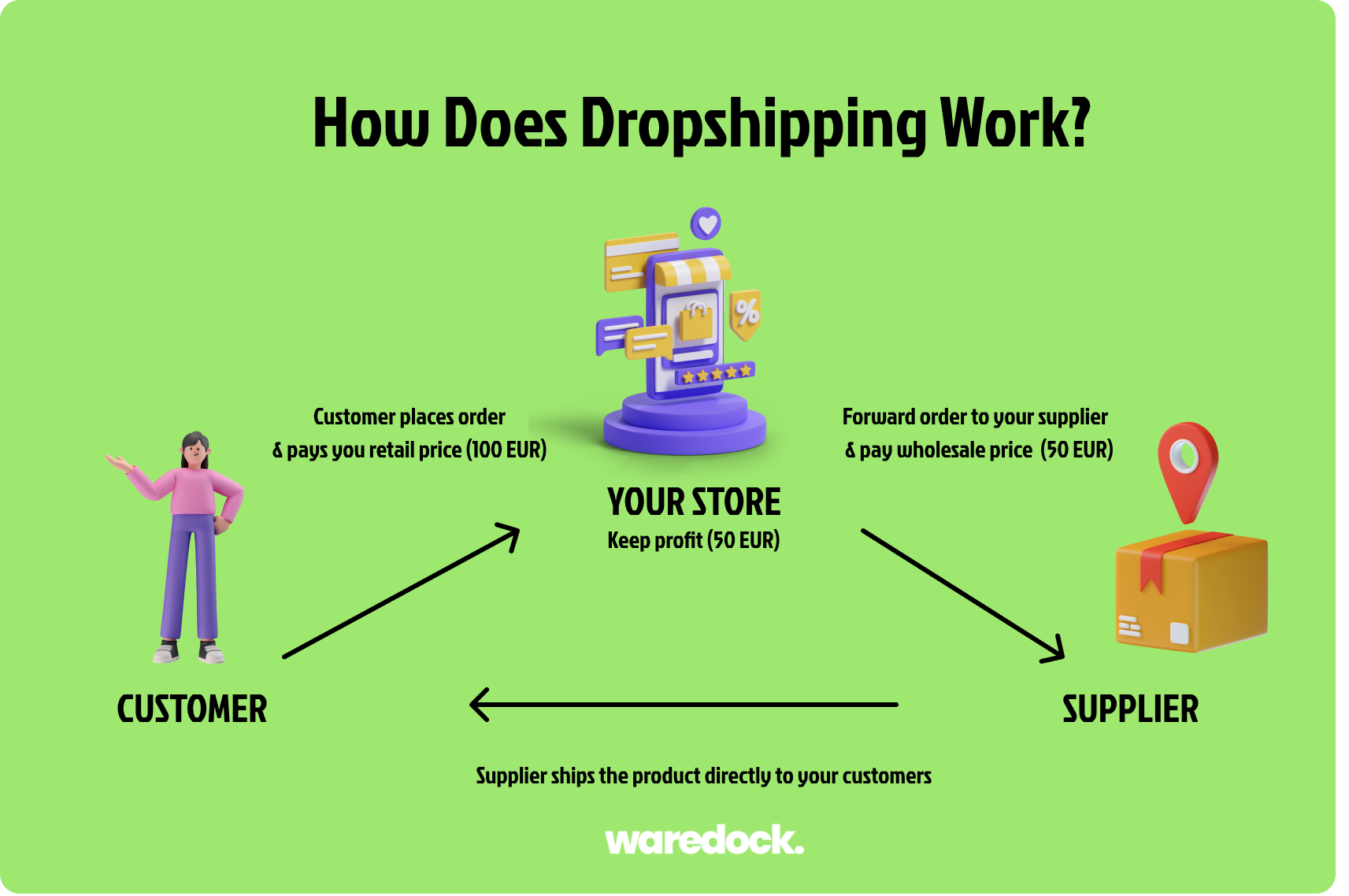
Financial flow
The financial logic is simple and elegant:
– A customer pays you the retail price.
– You forward the order to the supplier and pay them the wholesale price.
– The difference is your margin.
You pay for the product after you’ve already sold it. That reverses the classic retail cash-flow pain of buying inventory up front and hoping someone eventually wants it.
This structure is why dropshipping keeps coming back in waves: it radically lowers the cost of starting.
How Dropshipping Works (The Procedure)
Let’s map the full order lifecycle from setup to delivery. This is the “machine” you’re actually building.
Step 1: Setup and preparation
Before any money moves, you need infrastructure:
– You choose one or more suppliers and agree on pricing, shipping standards, and how damaged or returned items will be handled.
– You build an online storefront (for example, on Shopify, WooCommerce, Wix, or similar).
– You import products from the supplier’s catalog into your store. You customize titles, descriptions, photos, and pricing so they match your brand and your positioning.
Most modern dropshippers also connect automation tools that sync inventory, forward orders automatically to the supplier, and pull back tracking numbers afterward. That automation matters at scale.
Step 2. The customer buys
– A shopper visits your store, places an order, and pays your retail price.
– They immediately get an order confirmation from you. From their point of view, they’re dealing only with your brand.
Step 3. Forwarding the order
– The order details (product, quantity, shipping address) are sent to your supplier.
– You pay the supplier the agreed wholesale cost.
This step can be manual (you forward each order) or automatic (software sends the order to the supplier the moment the customer checks out).
Step 4. Fulfillment and shipping
– The supplier picks, packs, and ships the product directly to the customer.
– The package often includes either neutral labeling or, in some cases, your own branding (logo on packing slip, your return address, etc.).
– Tracking info is generated.
Step 5. Customer communication
– The tracking number is surfaced in your store so you can share it with the customer.
– The customer receives the package.
Notice the asymmetry:
– You own the relationship, the brand, the promise.
– The supplier owns the physical performance of that promise.
This asymmetry is the source of both the superpower and the pain of dropshipping.
Historical Context: Dropshipping Is Older Than TikTok
It’s tempting to think dropshipping was born on YouTube with neon thumbnails and “$10K IN 7 DAYS!!” energy. The core idea is actually much older.
Early practice
Forms of dropshipping emerged as early as the late 1920s. The basic move — sell something you don’t physically stock, then have it shipped from somewhere else — is older than the modern internet. The model stalled during the Great Depression but the core logic stayed alive inside wholesale distribution and catalog retail.
Catalog era
Mid-20th century retail giants used a similar playbook. Catalog companies would showcase products in print, accept orders by mail or phone, and then route those orders to manufacturers or wholesalers who shipped directly to the buyer. The retailer “sold” the thing but never personally touched the thing. Sound familiar?
Just-in-time philosophy
In the 1950s, industrial supply chains moved toward just-in-time logistics — keeping minimal inventory on hand and relying on fast, responsive fulfillment from upstream partners. That mindset (carry less, move faster, rely on others to hold stock) is spiritually aligned with dropshipping.
E-commerce and the explosion
When online retail took off, dropshipping evolved from “mail order hack” to “scalable internet play.” Early Amazon relied heavily on this logic. They offered a massive catalog of books and other goods, but they didn’t physically stock all of it. Instead, they passed certain orders to distributors and publishers who shipped directly to the buyer — sometimes even inside Amazon-branded packaging. That allowed huge selection without huge inventory cost.
Modern 2020s model
Now, with global manufacturing networks, automated storefront platforms, print-on-demand services, and ad targeting, a single person with a laptop can assemble:
– A storefront
– A marketing funnel
– A fulfillment chain spanning three countries
– A customer support inbox
That would have been unthinkable 30 years ago without a large company behind it.
Today, dropshipping sits inside a global ecommerce market worth hundreds of billions and projected to keep growing. The reason is structural: the model lets new sellers enter commerce cheaply, and it lets established sellers expand product lines without buying more warehouse space.
The Money: Financial Advantages
Dropshipping’s financial appeal is not subtle. It’s financial judo.
Low startup cost
Traditional retail says: buy inventory first, hope it sells. Dropshipping inverts that. You don’t buy inventory until someone has already paid you. That means:
– You avoid locking cash into stock you might never sell.
– You don’t need a warehouse lease.
– You don’t need packing staff.
– You don’t need shipping accounts on day one.
In practice, early costs are things like:
– Store platform subscription
– Domain name
– Samples from suppliers (this part matters; more on that later)
– Initial marketing budget
That’s dramatically cheaper than renting a unit, filling it with boxes, and praying.
Reduced overhead
Because storage, packaging, and shipping are handled by someone else, you skip:
– Warehouse rent
– Inventory carrying cost
– Packing materials
– Fulfillment labor
Your fixed costs stay low. Your business is mostly software, advertising spend, and time.
Cash flow control
You collect retail price up front. You then pay wholesale cost to the supplier. The delta in between is your gross margin. That timing matters. Good dropshippers treat cash flow like oxygen: they monitor how much margin is left after ad spend, payment fees, refunds, and taxes. That discipline keeps the business alive.
Scalability without physical expansion
If you suddenly start selling 5× as many units next month, you don’t personally have to hire five pick-and-pack workers or open another storage unit. Your supplier absorbs that operational load (assuming you chose a supplier who can actually handle that volume; we’ll talk about vetting later).
All of this gives you the ability to start fast, test fast, and scale fast — at least on paper.
Operational Flexibility: Why People Romanticize It
Dropshipping is famous for its flexibility, and that reputation is not undeserved. The model lets you operate like a liquid creature instead of a brick.
Geographic independence
You can run the business from anywhere with internet access. You don’t physically fulfill orders, so you don’t have to be in the same country as your customers or your suppliers. This is one reason the model attracts digital nomads.
Catalog freedom
Because you don’t pre-buy inventory, you can continuously experiment with products. You can:
– Add new items instantly.
– Remove underperformers with no sunk-cost guilt.
– Pivot from “camping gadgets” to “desk gadgets” in a week if the market tells you to.
That’s a huge difference from traditional retail, where you might be stuck with a pallet of slow-moving stock that quietly eats you alive.
Low-risk product testing
Dropshipping excels at validation. Let’s say you run an online pet accessory shop and you mostly sell dog toys. You’re wondering if you should branch into cat products. Instead of buying 500 units of cat tunnels and hoping, you list them via dropshipping and see if they move. If they do, great — maybe you eventually bulk order and improve margins. If they don’t, you quietly remove them and no one knows but you and your spreadsheet.
Scalability
Because fulfillment load is offloaded, scaling order volume doesn’t instantly break you. As long as:
– Your supplier can keep up,
– Your order routing is automated,
– Your customer support is responsive,
you can grow revenue without immediately adding headcount.
That said, flexibility is not the same thing as freedom. The next section explains why.
Core Challenges and Structural Weaknesses
Let’s be honest: dropshipping is not easy money. It’s fragile money. The exact forces that make it easy to start also make it brutal to sustain.
Thin margins
Your cost per unit is usually higher than a traditional retailer who buys in bulk. You’re buying one unit at a time. They’re buying pallets. You can’t beat them on raw cost.
At the same time, the entire internet is filled with other dropshippers selling the same item you’re selling, sometimes from the same supplier. That competition pushes prices down. Low price means thin margin. Thin margin means every ad dollar has to work.
It’s common for beginner stores to operate in the 10–20% gross margin range. That’s before you pay for ads, refunds, software, payment processing, and your own time.
Intense competition and copycats
Low barrier to entry means everyone can enter. If you find a product that converts well, someone else can usually find it too — and undercut you.
Branding difficulty
Most dropshipped products are generic. Many sellers are listing the same exact item, often with the same supplier photos. That makes it hard to build a brand people remember. That, in turn, makes it hard to charge premium pricing.
Limited control over quality and speed
Here is the single hardest pill: you are responsible for customer satisfaction, but you do not control the experience.
– You do not control the warehouse.
– You do not control the packing.
– You do not control how fast the item leaves the building.
– You might not even control the condition of the item when it arrives.
If the product arrives late or arrives broken, your customer does not email some warehouse in Shenzhen. They email you.
Shipping times and expectations
Customers are trained by next-day delivery. Dropshipping (especially cross-border dropshipping) can take a week or more. That time gap turns into angry support tickets unless you set expectations clearly on your site.
Inventory visibility
You’re listing products you don’t physically stock. If your supplier suddenly runs out and doesn’t tell you, you can end up selling something that no longer exists. That leads to cancellations, refunds, and one-star reviews.
Operational complexity with multiple suppliers
If one customer orders three items that come from three different suppliers, those items may ship in three different boxes, on three different days, with three different shipping costs. You are the one who has to explain that to a confused buyer.
Legal and reputational risk
You’re still legally the seller. That means:
– If the supplier ships counterfeit or trademark-infringing goods, you’re exposed.
– If the supplier quietly swaps materials and the item becomes unsafe, you’re exposed.
– If the supplier uses photos that don’t match reality, you’re exposed.
There are also outright scams in the ecosystem. Some “suppliers” will take orders and never ship, or ship low-quality knockoffs that ruin your reviews.
In short: dropshipping trades operational control for speed. That trade is powerful, but it can bite.
Strategic Use Cases: When Dropshipping Makes Sense
Here’s the part most beginner tutorials skip: dropshipping is often strongest when it’s not your entire business, but instead one of your business tactics.
Use case 1. Product testing and market validation
This is the classic smart play. You use dropshipping to test whether a product has demand before you ever commit to buying inventory in bulk.
– You list a new product.
– You run targeted ads or organic content.
– You watch conversion rate, return rate, complaints.
– If it works, you consider moving that product to in-house fulfillment for better margins and better control.
– If it doesn’t, you remove it and move on.
This “test with dropshipping, scale with inventory” loop is how serious ecommerce operators quietly use the model.
Use case 2. Solving nasty logistics
Some products are painful to store and ship yourself:
– Heavy or bulky (gym equipment, furniture).
– Fragile (glass, electronics with delicate parts).
– High-value (fine jewelry, collectibles) where security matters.
– Temperature- or condition-sensitive (refrigerated items, light-sensitive items).
In those categories, letting a specialist supplier handle storage and shipping can be smarter than trying to build that capability yourself.
Dropshipping also helps you sell into geographies where you don’t (yet) have a warehouse. You can effectively “test” a new region. If sales justify it, you later invest in local fulfillment.
Use case 3. Extending an existing brand
If you already have a brand and a customer base, dropshipping can be used to widen your catalog without taking on more inventory risk.
Examples:
– You sell premium skincare. You add related accessories (jade rollers, travel cases) via dropshipping rather than buying a pallet.
– You run a lifestyle brand. You dropship complementary décor or art prints that match your aesthetic, even though you don’t produce them yourself.
Dropshipping can also act as overflow protection. If a heatwave, holiday rush, or disaster hits your warehouse, a backup dropshipping supplier can keep orders flowing instead of letting you stock out.
Use case 4. Print-on-demand (POD)
Print-on-demand is a close cousin of classic dropshipping. A POD provider prints your custom design on T-shirts, mugs, posters, etc. only after someone orders. Then they ship it in your branding.
Why POD matters:
– You get more control over the branding and perceived uniqueness of the product.
– Customers are more tolerant of made-to-order shipping times if they understand it’s custom.
– You can justify higher margins because the item is personalized, not generic.
This is one of the most defensible modern uses of “dropshipping-like” fulfillment because it gives you differentiation, not just arbitrage.
Keys to Success in 2026
The market is bigger than ever. It’s also noisier than ever. Winning in 2026 means acting like a disciplined operator, not a gambler.
a) Choose the right niche and products
Generic gadgets that 400 other stores are already blasting on social media? Hard mode.
You want:
– Products that are not easily found locally.
– Products light enough to ship cheaply.
– Products with enough perceived value that you can afford both ads and returns.
– Products that resonate with a specific audience you can actually reach (pet owners, hobbyists, niche sports, certain professions).
The tighter the niche, the easier the marketing story.
b) Vet and control for quality
Never list a product you haven’t personally sampled. This sounds tedious. It saves reputations.
Sampling lets you:
– Check actual quality (not supplier photos).
– Check packaging and unboxing experience.
– Check delivery time.
– Catch red flags early: wrong color, weird smell, dangerous parts, etc.
If you can’t be proud to open it yourself, don’t sell it.
c) Automate the boring, but never fully abdicate
Use integration tools to:
– Sync inventory so you’re not selling out-of-stock items.
– Forward orders instantly and accurately.
– Pull tracking numbers back into your store.
– Handle bulk ordering without manual copy-paste.
Automation keeps you sane. But don’t sleepwalk. You still need to monitor supplier performance, refund rates, delivery delays, and angry messages.
d) Become obsessed with marketing math
Traffic is oxygen. You live or die on visibility.
That means:
– Paid ads, especially search ads that target people already looking for the exact thing you sell.
– Organic content (SEO, social video, influencers, user-generated content like unboxing clips and reviews).
– Email capture and retention. An owned email list lets you re-sell without paying for ads every time. Even basic flows — welcome series, abandoned cart recovery, post-purchase follow-up — can noticeably lift revenue per visitor.
You cannot “hope people find it.” You have to drag them there.
e) Set expectations and support like a grownup
Customers will forgive slower shipping if they feel informed and respected. They will not forgive silence.
Be explicit on:
– How long shipping typically takes.
– How tracking works.
– How returns are handled.
– Who to contact for help.
Fast, human customer service is not optional. It’s your only defense when you don’t control the warehouse.
f) Treat trust as your real product
In a market full of flimsy clones and scammy storefronts, legitimacy itself is a differentiator.
That means:
– Professional-looking site design (not junky, not full of typos, not obviously copy-pasted supplier text).
– Clear policies.
– Original product photos or at least customized, high-quality visuals.
– Real reviews and social proof.
You’re not just selling the product. You’re selling the promise that buying from you is safe.
Platforms and Tools
A modern dropshipping operation is basically three layers glued together: storefront platform, supplier network, and automation/intelligence layer.
Storefront platforms
These are where your brand lives and where customers check out. The dominant players are platforms like Shopify, WooCommerce (WordPress), Wix, and BigCommerce. Each one gives you the basics:
– Product pages
– Shopping cart and checkout
– Payment processing
– Tax handling
– Basic analytics
They also act as the thing you control. It’s “your store.”
Different platforms have different flavors:
– Shopify is widely praised for being friendly to beginners and having a giant ecosystem of apps.
– WooCommerce (WordPress) is powerful and flexible if you want deep control and you’re comfortable managing more of the stack yourself.
– Wix leans into simplicity and built-in automation, including AI helpers for writing product copy, FAQ text, etc.
– BigCommerce is common for more established operations that want an all-in-one commerce platform, especially if you’re already thinking about omnichannel.
Marketplaces like Amazon, eBay, and Etsy also allow dropshipping under certain rules, but the tradeoff is that you’re renting shelf space in someone else’s mall. You get traffic, but you don’t fully own the customer relationship.
Supplier and catalog tools
These are how you actually find what to sell and connect with people who will ship it.
You’ll see:
– Global manufacturing marketplaces (for example, large wholesale directories where you can filter for suppliers willing to fulfill single-item orders).
– Regional supplier hubs that specialize in certain geographies or categories (furniture, pet goods, electronics, etc.).
– Print-on-demand networks that let you upload your own designs and sell “made for you” items on demand.
They solve the “what can I reliably sell and who will actually ship it for me?” problem.
Automation and integration tools
This layer is the nervous system.
The job here is:
– Import products from supplier catalogs directly into your storefront.
– Sync stock levels automatically so you’re not selling items that are already gone.
– After an order comes in, forward the order details to the supplier immediately without manual copy-paste.
– Pull shipment tracking numbers back into your storefront and into payment platforms like PayPal so customers can track their order and you’re protected in disputes.
– Batch processing so you can fulfill 50 or 100 orders in one go instead of one at a time like a medieval scribe.
Without this automation, you burn out manually relaying spreadsheets back and forth. With it, you can operate like a lightweight brand instead of a frantic clerk.
Research and “spy” tools
These are not optional in 2026. They’re how you survive the margin war.
They let you:
– See what products are trending right now in social commerce channels like TikTok Shop.
– Track which items specific rival stores are actually selling (not just listing).
– Monitor ad creative and ad spend patterns from other sellers to reverse-engineer what’s working.
– Watch pricing, shipping times, and reviews across marketplaces to spot opportunities.
This intelligence layer is what lets you pick products with real demand instead of gambling blindly, and it’s what lets you pivot before a niche gets flooded.

Supplier Vetting: Your Survival Checklist
Here’s the non-negotiable truth: your supplier can quietly destroy you. Vetting them is not “nice to have.” It is existential.
Before you lock in a supplier, do the following.
Order samples
You need to see the product in your own hands. Judge:
– Actual build quality
– Packaging quality
– Accuracy vs. photos and description
– Delivery time
– Condition on arrival
If it shows up late, dented, or scammy-looking, assume that’s what your customers will get.
Check fulfillment speed and capacity
Ask blunt questions:
– How fast do you ship after receiving an order?
– Which shipping options are available and to which regions?
– Do you provide tracking numbers every time?
– Can you handle spikes in volume, or do you melt down if I suddenly sell 5× in a weekend?
Slow, unreliable fulfillment = refunds and chargebacks. Enough chargebacks and payment processors will punish or freeze you.
Check stock visibility
You need to know whether the product is actually in stock. If your supplier can’t or won’t provide inventory visibility (even via basic sync), you’re blindly selling ghosts. That leads to cancelled orders and angry emails.
Clarify returns and damage policy
When something arrives broken, who pays?
– Can the customer return it directly to the supplier, or does it have to come back to you?
– Do you get reimbursed for supplier faults (manufacturing defects, wrong color, etc.)?
– How long does reimbursement take?
Brands live or die on how they handle “this arrived broken, help.”
Check legal and ethical risk
Are they shipping counterfeit goods? Are they using stolen designs or infringing logos? If yes, run. You are the seller of record. You are the one customers (and lawyers) will come after.
Test communication
Email or message them the way an actual customer emergency would happen. How fast do they respond? Is the answer clear, or vague and dismissive? If you can’t get fast, useful responses now, you definitely won’t when orders are flying and tempers are hot.
Get terms in writing
You’re not “just vibing.” You’re running a business. Get a clear agreement that covers:
– Wholesale pricing
– Shipping responsibilities and timelines
– Quality expectations
– Handling of defective items and returns
– Branding/labeling (can they ship with your name on the packing slip?)
– Data sharing (inventory feeds, tracking updates)
If something goes wrong, that agreement is what you point to.
Bringing It All Together
Dropshipping is not a money glitch. It’s a specific fulfillment model with a specific power curve.
Power curve:
– You can launch fast.
– You can test products with very little capital.
– You can scale catalog breadth without renting warehouses.
– You can expand into new regions without pre-positioning stock.
– You can run the whole operation from a laptop if you’re disciplined.
Cost of that power:
– Margins are thin, so every ad dollar and refund matters.
– Competition is intense and copying is instant.
– You carry full reputational and legal risk for products you didn’t make and never touched.
– Your entire brand depends on suppliers you do not fully control.
So the sustainable play in 2026 is not “spam random products and hope.” The sustainable play is to use dropshipping as:
– A test lab for new products and niches.
– A surgical logistics tool for products that are annoying or expensive to store and ship yourself.
– A backup and extension mechanism for a brand you’re actively building.
– A stepping stone toward owning the best-performing products outright, increasing your margins, and tightening control over the customer experience.
In that frame, dropshipping stops being hype and starts being infrastructure. It becomes one instrument in your toolkit, not the whole song.
Looking for A Dropshipping Fulfillment Partner?
Dropshipping has become a very popular model for ecommerce. Also, dropshipping as a remedy to inventory shortages can be an active supply chain strategy. Waredock is able to procure items from your existing suppliers on your behalf, arrange dropship price agreements, take care of the shipping and track & trace, and even source additional product categories that are a good fit for your existing portfolio.