

A branded unboxing can make an online order feel like a gift. It can also add a euro per order, fill pallet places with printed boxes and slow down packing in the busiest weeks of the year. This guide covers the main packaging types for eCommerce, what branded packaging really costs per order once a warehouse is involved, how to brief your fulfilment partner, how to prepare holiday and Christmas packaging, and when plain packaging is the smarter choice.
Quick answer: Branded packaging is a design choice that becomes an operations cost as soon as it reaches the warehouse. In our worked example, a printed mailer, tissue, sticker and card add about €1 per order over a plain mailer, once materials, packing time and storage are counted. It pays off best for gifting, beauty, fashion and premium direct-to-consumer brands with healthy margins, and rarely for low-margin or commodity products. Treat packaging as stock with reorder points, give your 3PL photo-based packing instructions, and for Christmas switch to stickers, ribbon, tissue and printed cards if printed seasonal boxes can no longer arrive in time.
Jump to: Branding levels · Packaging types · What an unboxing is made of · Branded packaging at a 3PL · Cost per order · Holiday and Christmas packaging · Personalisation · Does it pay back? · EU packaging rules · How to brief your 3PL · FAQ
Branding levels compared
Branded packaging is not all or nothing. Most brands start small and move up as volume and margin allow.
| Level | Added cost per order (indicative) | Set-up | Extra packing time | Suits |
|---|---|---|---|---|
| Plain mailer or box | Baseline | None | None | High-volume, low-margin and commodity products |
| Branded tape, sticker or label | A few cents | Small print run | A few seconds | Brands testing branding on a budget |
| Printed mailer box or bag | About €0.30–0.80 over plain | Design, print set-up, minimum order | Little, if the size fits the product | DTC brands with one or two main parcel sizes |
| Full branded set (box, tissue, sticker, card) | About €0.80–1.50 over plain | Moderate | 20–60 seconds | Beauty, fashion, gifting, premium DTC |
| Rigid gift box or bespoke presentation | €2 or more over plain | High, larger minimums | One minute or more | Luxury, jewellery, high-margin gifts |
Ranges are indicative and depend on quantities, finishes, country of print and your warehouse’s rates. Get your own quotes before deciding.
Four packaging types for online orders
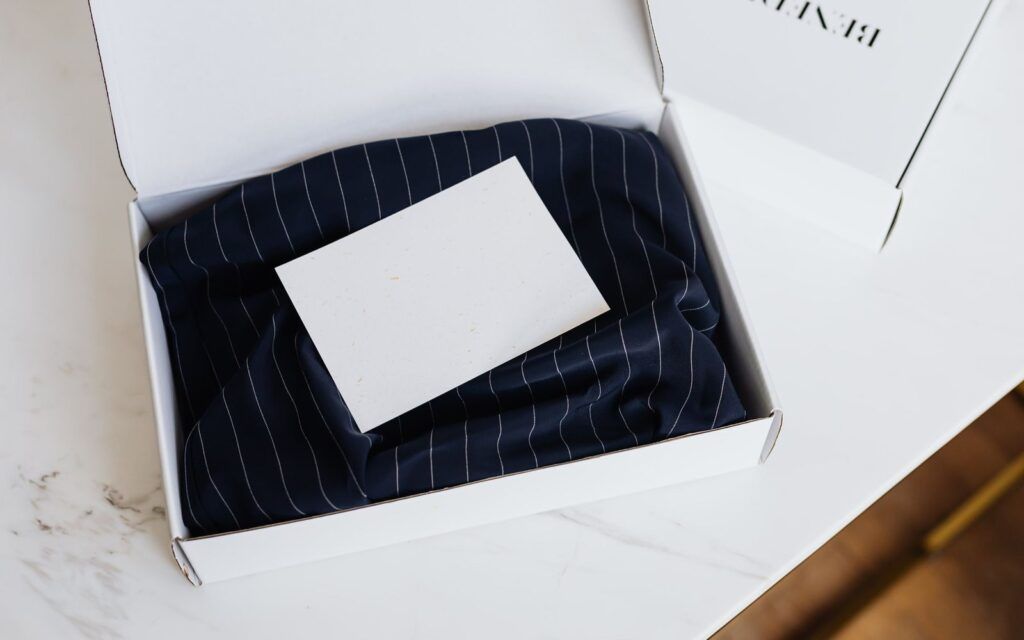
1. Printed mailer box with tissue and insert
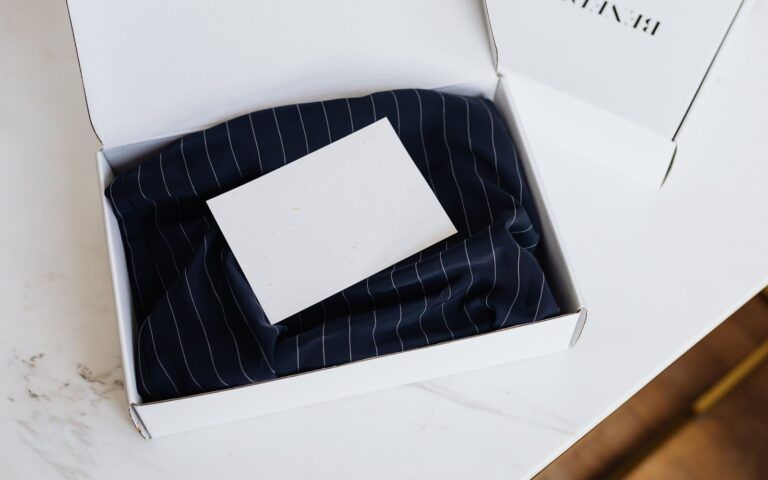
The classic branded unboxing: a printed corrugated mailer box, the product wrapped in tissue paper and closed with a sticker, plus a card or note on top. It gives the strongest first impression and protects well, but takes the most storage space and packing time. Printing the inside of the box gives the reveal without a fully printed outside, which also draws less attention from parcel thieves.
2. Kraft mailer with labels and stickers
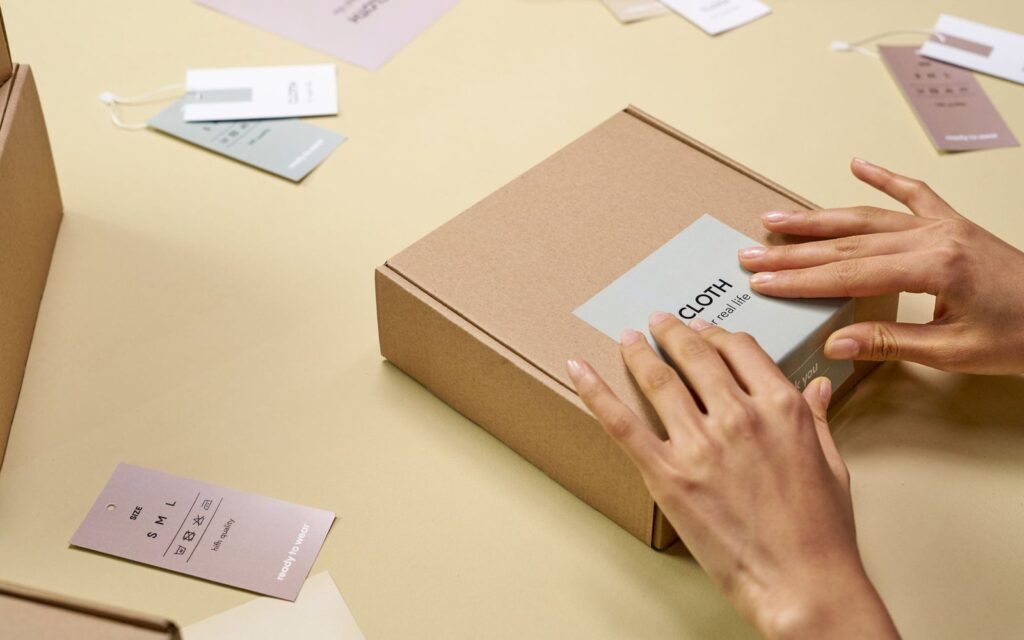
A brown kraft box or mailer with a printed sticker, stamp or label is the low-cost route to a branded look. It fits brands that want a natural, recyclable feel and lets you change seasonal designs by printing new labels instead of new boxes. Scuffs show less than on white or coloured print.
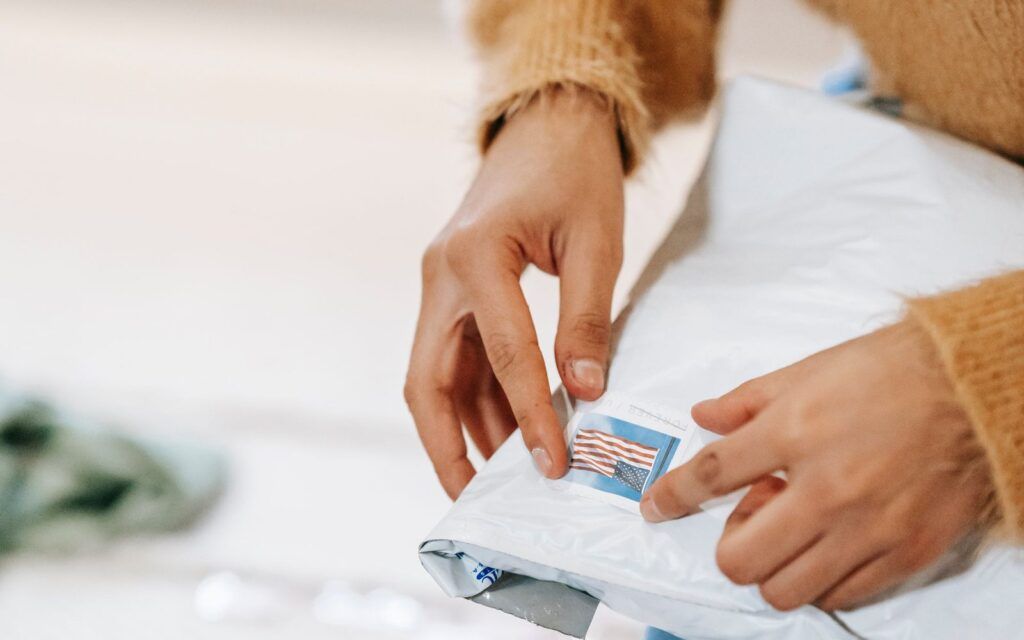
3. Paper or poly mailer bags
For clothing and other soft goods that don’t need a box, mailer bags are light, cheap to ship and take very little storage space. Paper mailers and bags made from recycled polyethylene can both be printed. Presentation is simpler, so the tissue wrap and card inside do most of the brand work.
4. Holiday and gift packaging
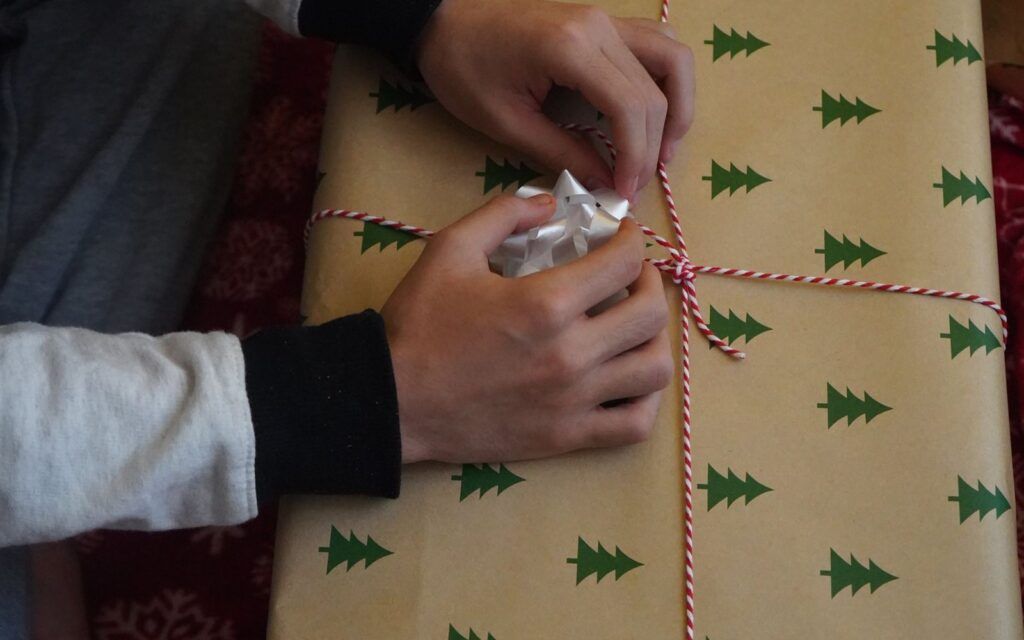
Seasonal packaging, from Christmas gift wrapping and ribbon to printed sleeves and gift cards, turns an order into a present the customer can pass on directly. It can lift average order value through paid gift wrap, but it is the most time-sensitive packaging of the year: anything left over in January is often unusable. See holiday and Christmas packaging below.
What an unboxing is made of
Every branded unboxing has three layers, and each adds its own cost and handling:
- Outer packaging: the box or mailer the customer sees first. It has to survive the parcel network as well as look good.
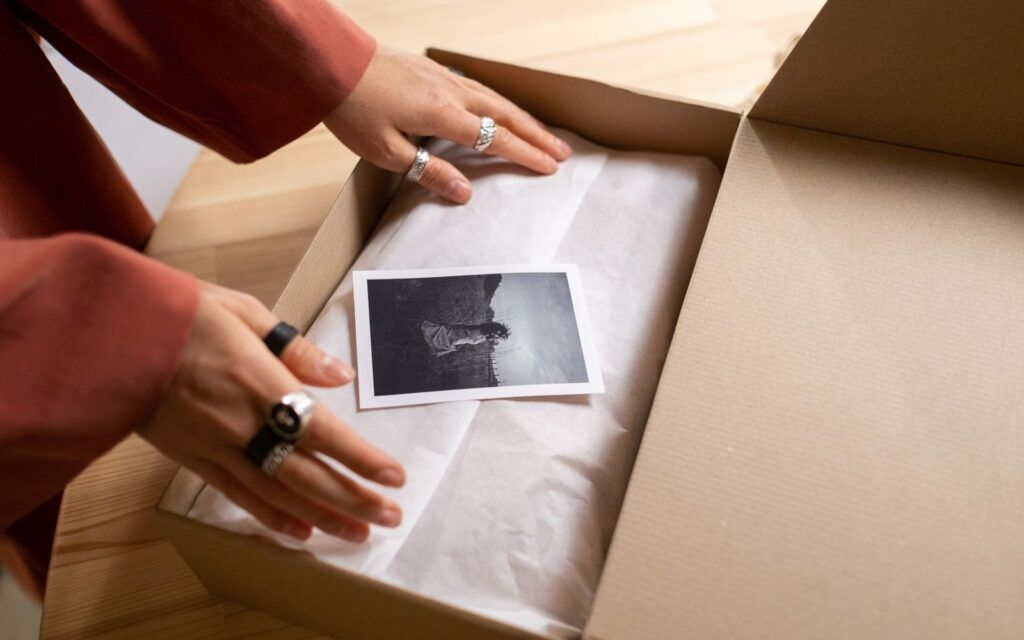
- Inner presentation: tissue, wrap, shaped inserts or void fill. Tissue looks good but protects little, so fragile products still need proper protection underneath. See how to avoid shipping damage.
- Inserts: thank-you cards, care instructions, discount codes, samples and flyers. Each one is an extra item to place, and the one most likely to run out.
Running branded packaging through a 3PL
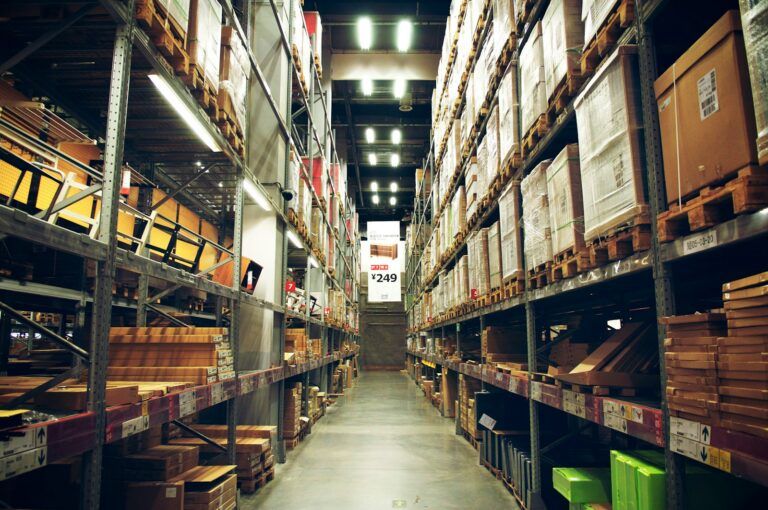
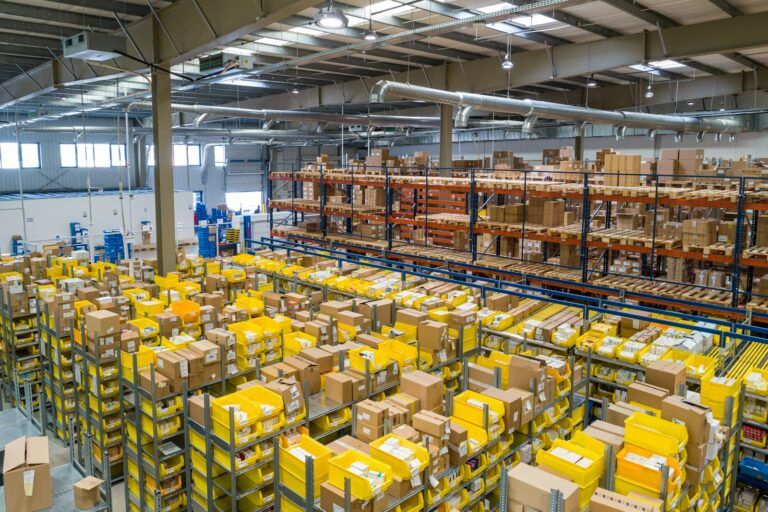
Once printed packaging reaches a warehouse it behaves like stock: it has to be received, stored, counted, picked and replenished.
Storage: you pay for the space
Your fulfilment partner stores every box, sleeve and card you supply and usually charges for the space like any other stock. Flat-packed mailers are compact; rigid gift boxes often arrive assembled and fill pallets quickly. Large print runs bought for a better unit price can mean paying for storage for many months, so balance price breaks against storage costs.
Packing time and consistency
Each layer adds seconds at the packing bench. Folding tissue, placing a sticker, adding a card and closing a printed box can add 20–60 seconds per order. At 1,000 orders a month, 30 extra seconds is more than eight hours of packing. Simple, photo-based packing instructions give far more consistent parcels than complex ones, especially when temporary staff join in peak season.
Running out of inserts
When cards or boxes run out, the warehouse can hold orders, ship without them or use a substitute. Agree the fallback rule in advance and track packaging as inventory with reorder points that include your printer’s lead time. Limited-edition holiday inserts usually can’t be reprinted in time, so order a buffer.
What branded packaging costs per order
Materials are the cost brands see first. Packing time and storage appear later on the fulfilment invoice, so comparing branded and plain packaging on materials alone understates the difference.
Worked example at 1,000 orders a month (illustrative, prices without VAT):
- Plain mailer: €0.45 per order.
- Branded set: printed mailer €1.00, tissue €0.10, sticker seal €0.04, printed card €0.08 = €1.22 per order.
- Material uplift: €1.22 − €0.45 = €0.77.
- Packing uplift: 30 extra seconds at €24 an hour = €0.20.
- Storage uplift: one extra pallet of packaging at about €20 a month = €0.02.
- Total: about €0.99 per order, or roughly €990 a month, plus one-off design and print set-up.
On a €90 order with a healthy margin, €1 is easy to justify. On a €20 product with a thin margin, it can take a large share of the profit. Work out how many extra repeat orders or reviews the packaging must bring to pay for itself, and ask your 3PL to quote each branded step as a separate line so you can drop the ones that cost the most for the least effect.
Set-up and dead stock: custom printing comes with design, plates or cutting dies and minimum order quantities, and the unit price falls as quantities rise. That tempts brands to order too much. A logo change, new address or new product size can make the remaining stock unusable, so young brands are usually better off with smaller runs at a higher unit price.
Holiday and Christmas packaging
The holiday season is when packaging matters most to customers, many orders are gifts, and warehouses and carriers are at full capacity. Plan it like a campaign.
- Decide early what is seasonal. Printed Christmas boxes need weeks of printer lead time. If it is too late for printed boxes, use seasonal stickers, ribbon, coloured tissue and printed cards on your normal packaging; they can be produced in days and leftovers cost little.
- Make gift options clear at checkout. Offer gift wrap and a gift message as paid or free options, and decide whether gift orders ship without prices or with a gift receipt instead of the invoice or packing slip.
- Pre-build gift sets. Bundles and gift boxes can be kitted in advance in quieter weeks, so peak-day packing is just pick, label and ship.
- Brief the warehouse with photos. Show exactly how a gift-wrapped order should look, where the message card goes and what is left out of the parcel.
- Order a buffer of seasonal materials and agree what happens if they run out before the last shipping day.
- Publish your last order dates for Christmas delivery in each country, based on your carriers’ cut-offs, and add a clear message when a date has passed.
- Plan returns and exchanges. Gift returns arrive in January, often in seasonal packaging. Extended holiday return windows and easy exchanges keep gift recipients happy.
Seasonal packaging that won’t go to waste
Printed Christmas boxes: strongest look, but long lead times and leftovers are hard to use in January. Plain or branded box plus seasonal sticker, ribbon and card: almost the same effect, short lead time, and the box stays usable all year.
Personalisation at scale
Printed personalisation, such as a card with the customer’s name or gift message printed from order data, scales well and adds only a few seconds. Handwritten notes don’t: a short note can take a minute or more, so many brands keep them for first orders, large orders or VIP customers. Gift messages need a clear rule for where the card goes and which documents are left out.
Does branded packaging pay back?
Most evidence comes from consumer surveys, and they consistently find that shoppers say they notice and like memorable packaging and are more likely to buy again. Those are statements of intent, not measured sales. We found no independent study that proves how much revenue branded packaging adds for a given brand, and several widely shared “uplift” statistics can’t be traced to a primary source.
So test it. Use branded packaging for one customer segment or one period and compare repeat purchase rate, reviews and social mentions with a control group, a simple A/B test. Packaging works best alongside other customer retention levers such as a discount code on the card, follow-up emails and easy returns.
Branded packaging rarely pays back for low-margin commodity products, replacement parts and consumables that customers buy on price, or for early-stage brands that can’t yet afford print minimums. And it can’t rescue a late delivery or a wrong item: get order accuracy and delivery right first.
EU packaging rules to know
Packaging and Packaging Waste Regulation (PPWR)
The EU’s Packaging and Packaging Waste Regulation (EU) 2025/40 has applied since 12 August 2026. It requires packaging to be kept to the minimum needed and, from 2030 at the earliest, limits empty space in e-commerce, transport and grouped packaging to 50%, with void fill such as paper or air pillows counting as empty space. Oversized branded boxes with lots of filling will need a rethink. The European Commission publishes updates and guidance.
Extended producer responsibility
Under extended producer responsibility, companies that put packaging on the market pay for its collection and recycling. In most EU countries, online sellers must register and report the packaging they ship to consumers there, for example in Germany’s LUCID packaging register. More and heavier branded packaging means higher fees. See EPR.
Sustainability and elaborate packaging pull in different directions: more layers mean more material and more for the customer to throw away. Right-sized boxes, recyclable paper tissue and fewer inserts keep presentation without the waste. See sustainable packaging.
How to brief your 3PL on branded packaging
- Which packaging and inserts go with which products and order types, with a photo of each finished parcel?
- What does each branded step cost per order, quoted as separate lines?
- How much storage will the packaging take, and how is it charged?
- Is packaging tracked as stock with reorder alerts based on your printer’s lead time?
- What happens when a box or insert runs out: hold, ship without or substitute?
- How are gift wrap, gift messages and handwritten notes handled, and at what cost?
- How is fragile protection kept under the presentation layer?
- Can you approve a sample before launch and review finished parcels regularly, especially after peak?
How Waredock handles branded packing
Branded boxes, mailers, tissue, thank-you cards, samples and flyers, plus gift wrapping, personalised notes and seasonal packaging, are part of our value-added services. We build a sample for you to approve, save the packing instructions per product in the Waredock platform and follow them on every order. Inserts and branded packing are charged per order, gift wrapping per order and packaging materials at cost unless you supply your own, and kits can be prepared in advance for launches and holidays.
Related: Kitting · Pick and pack · Beauty fulfilment · Fashion fulfilment · Flash sale strategy · Returns handling
Frequently asked questions
Can a 3PL pack orders in my own branded packaging?
Yes. Most fulfilment providers pack with packaging you supply, such as printed boxes, tissue and cards, usually for an extra fee per order plus storage for the packaging.
How much does branded packaging add per order?
In our illustrative example, a printed mailer, tissue, sticker and card add about €1 per order compared with a plain mailer, once materials, extra packing time and storage are included.
What are the main types of eCommerce packaging?
Printed mailer boxes with tissue and inserts, kraft boxes with branded labels or stickers, paper or poly mailer bags for soft goods, and gift or holiday packaging such as wrapping, ribbon and seasonal sleeves.
How early should I order Christmas packaging?
Printed seasonal boxes need several weeks of printer lead time plus delivery to the warehouse. If that is too late, use seasonal stickers, ribbon, tissue and printed cards on your normal boxes, which can be produced in days.
What happens if my inserts run out?
The warehouse follows the fallback rule you agreed: hold orders, ship without the insert or use a substitute. Tracking packaging as stock with reorder points prevents most stockouts.
Is branded packaging worth it for low-margin products?
Rarely. A branded sticker or tape on plain packaging gives much of the effect for a few cents per order.
Do EU rules limit oversized packaging?
Yes. The EU Packaging and Packaging Waste Regulation requires minimal packaging and, from 2030 at the earliest, limits empty space in e-commerce packaging to 50%, with void fill counted as empty space.
Sources
Regulatory details were checked in November 2026. Cost figures are illustrative examples, not quotes.