



Sweden is the biggest eCommerce market in the Nordics and one of the most mature in Europe. Swedes shop online often, pay with Swish and Klarna, expect fast delivery, and buy second-hand more than almost anyone. Unlike Finland, Sweden has its own Amazon store, and its domestic retailers are strong enough that Swedes buy from abroad less than their neighbours. This guide ranks the top marketplaces in Sweden in 2026, covers the challengers and start-ups worth watching, and shows how to get orders to Swedish buyers.
Quick answer: The marketplaces that matter most for sellers in Sweden in 2026 are Amazon.se (the most visited retail site in Sweden), Zalando (fashion), CDON and Fyndiq (Nordic marketplaces from the same group), Elgiganten Marketplace (electronics), Tradera and Blocket (second-hand and classifieds), and retailer marketplaces such as Åhléns and Stadium. Temu and Shein are the fastest-growing foreign platforms. Swedes spent SEK 153–166 billion online in 2025, depending on the survey, and Temu has overtaken Zalando as the second most favoured international marketplace (PostNord, spring 2026).
Jump to: Market at a glance · Nordic hub · Cross-border · Marketplaces compared · The top marketplaces · Challengers and start-ups · Big retailers, not marketplaces · Who should sell where · What Swedish buyers expect · Shipping to Sweden · FAQ
The Swedish eCommerce market at a glance
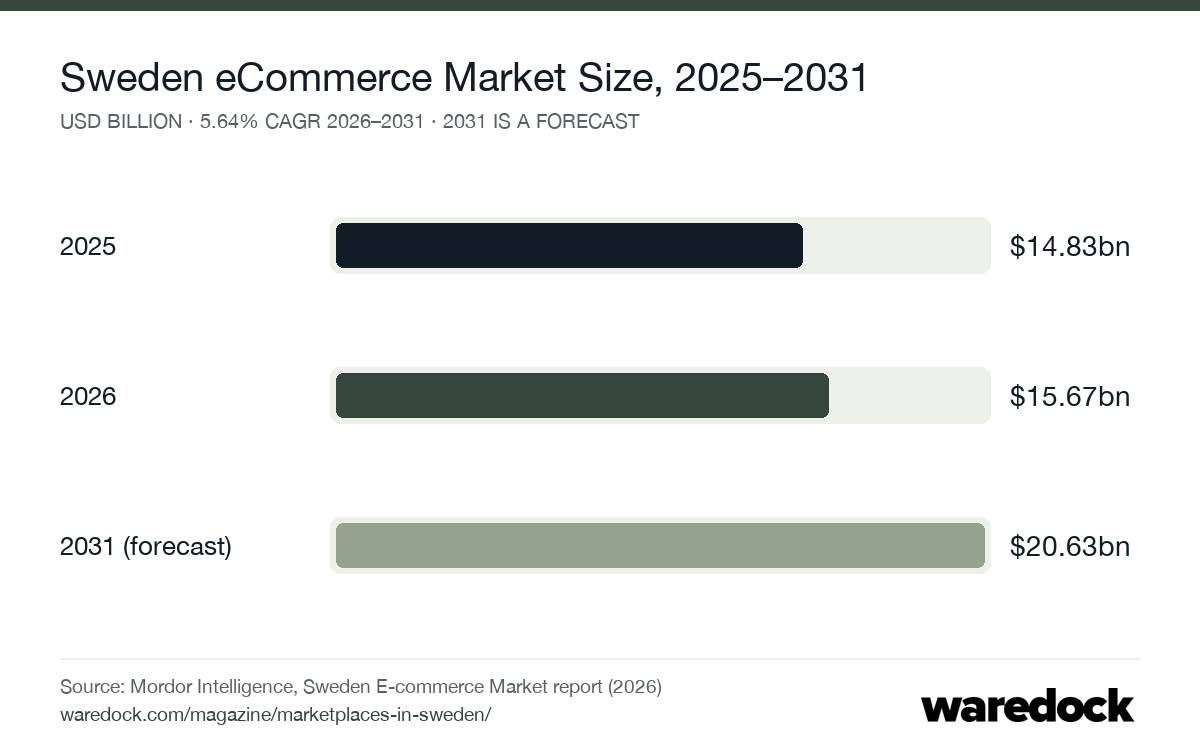
Swedish online retail hit a record in 2025. PostNord’s E-barometern puts consumer eCommerce at SEK 153 billion, up 10% on 2024 and above the pandemic peak of 2021. Svensk Handel (the Swedish Trade Federation) estimates SEK 166 billion, up 4%, with clothing and shoes the largest category, followed by home electronics. The two surveys measure differently, so treat them as a range. Mordor Intelligence, which also counts B2B and consumer-to-consumer sales, sizes the market at USD 15.67 billion in 2026, growing 5.64% a year to USD 20.63 billion by 2031.
Source: Mordor Intelligence, Sweden E-commerce Market report (2026). Includes B2C (70% of the total), B2B and C2C. 5.64% CAGR 2026–2031.
What the numbers mean for sellers:
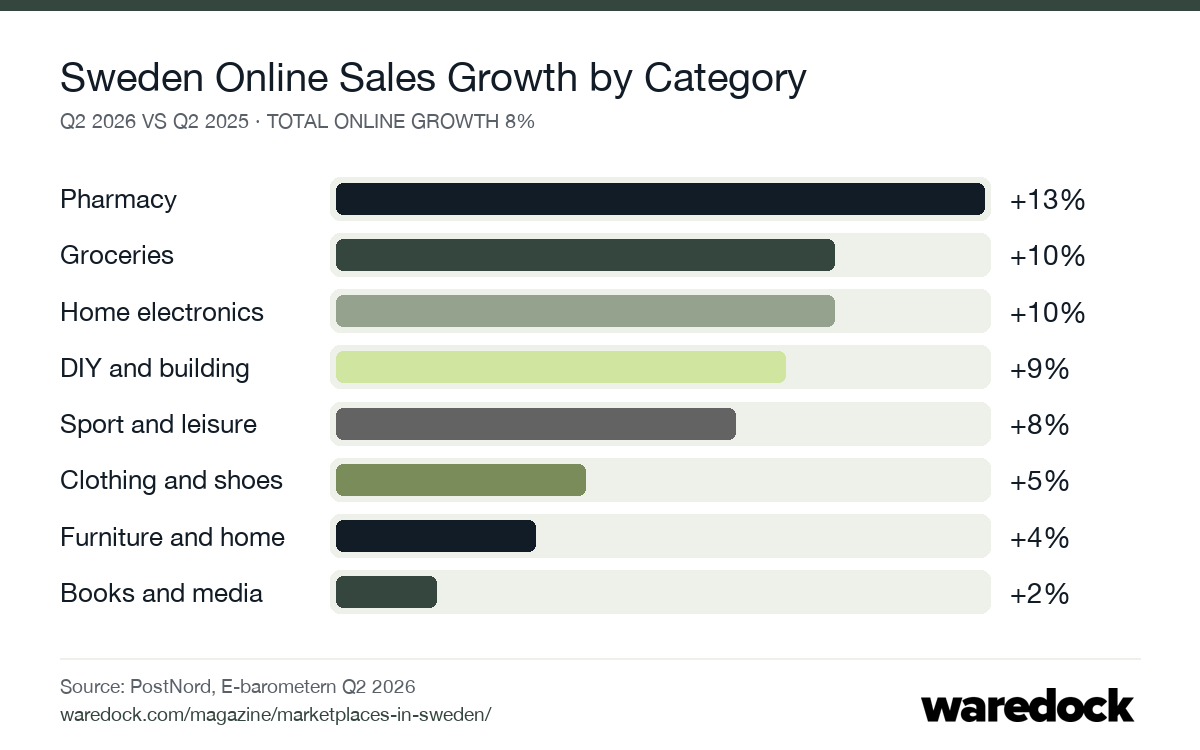
- Online shopping is routine. 87% of Swedes shopped online in the past 30 days, one of the highest shares in the Nordics (PostNord, autumn 2026). eCommerce makes up about 15% of Swedish retail, and online sales grew 8% in Q2 2026, with every category growing (PostNord E-barometern Q2 2026).
- Swedes shop at home first. Almost 2 in 3 Swedes bought from a foreign online store in the past year, fewer than a year earlier: 73% of men but only 57% of women (PostNord, autumn 2026). Many simply find what they need in Sweden.
- Sweden is the Nordic hub. Sweden is the most popular foreign market for online shoppers in Finland, Norway and Denmark (PostNord, autumn 2026), so a Swedish storefront or Nordic marketplace listing often reaches buyers across the region.
- But foreign parcels are rising. One in four online parcels came from abroad in 2025, 32% more than in 2024. China is the top origin country for Swedish cross-border shoppers (37%), ahead of Germany (27%), the UK and the US (21% each) and Denmark (19%) (U.S. Commercial Service). China’s lead is shrinking, though: it was the country of 27% of Swedes’ latest cross-border purchases in 2026, down from 33% in 2025, as new EU customs rules on low-value imports take effect (PostNord, autumn 2026).
- Price comparison and AI are the norm. 66% of Swedes often compare prices before buying, and 59% used AI when shopping for physical products in the past three months: 76% of 18–29-year-olds but 32% of 65–79-year-olds. Most use it to research product information (41%) and compare products and prices (29%) (PostNord, autumn 2026). Clear specs, prices and delivery times on every listing help both shoppers and AI assistants recommend you.
- Electronics and fashion lead, pharmacy grows fastest. Consumer electronics held the largest category share in 2025 at 25.65% (Mordor Intelligence). In Q2 2026, online pharmacy sales grew 13%, groceries and home electronics 10%, and clothing 5%.
- Second-hand is mainstream. 7 in 10 Swedes bought or sold second-hand online in the past three months (PostNord, autumn 2026), and more than 8 million second-hand parcels were sent in Q2 2026, up 36% (E-barometern Q2 2026). Clothing and shoes are the most common second-hand category (44%).
Source: PostNord, E-barometern Q2 2026. Total online growth: 8%.
Sweden is the Nordic shopping hub
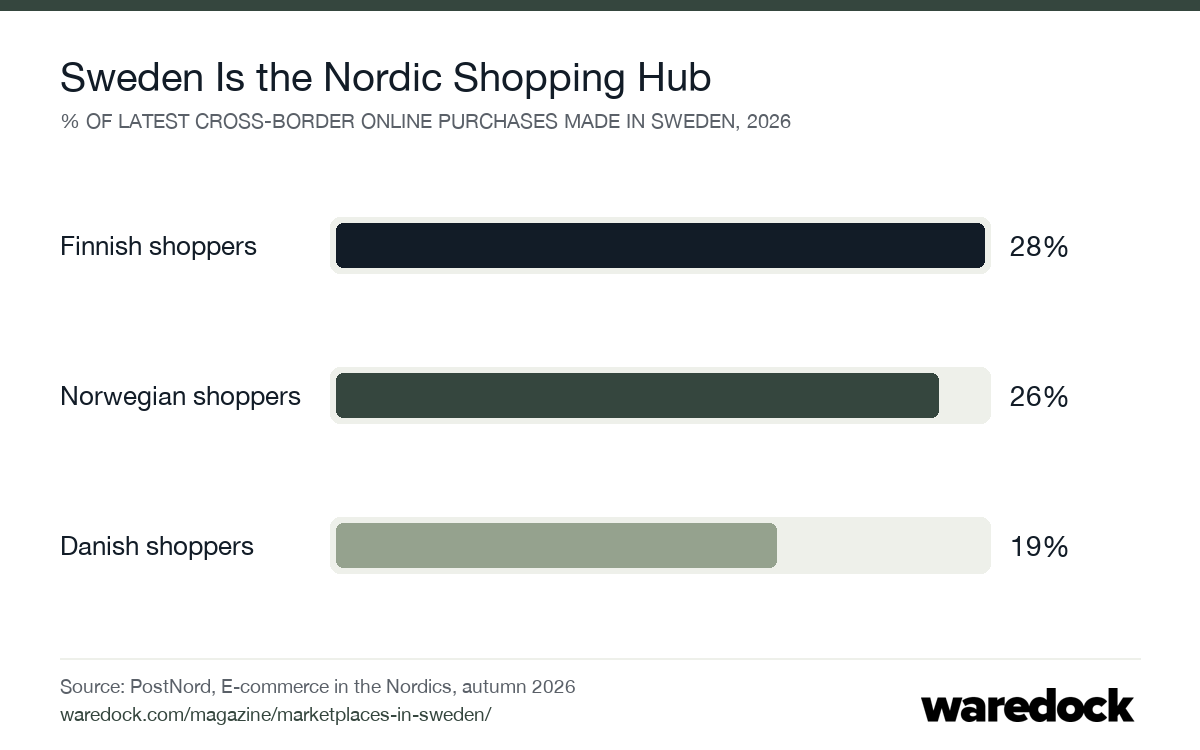
Sweden matters beyond its own 10.5 million people. It is the most popular foreign market for online shoppers in Finland, Norway and Denmark: Swedish stores took 28% of Finns’ latest cross-border purchases in 2026, 26% of Norwegians’ and 19% of Danes’ (PostNord, autumn 2026). In Finland and Norway, Sweden has now overtaken China. A Swedish storefront or a Nordic marketplace listing therefore often reaches buyers across the region.
Source: PostNord, E-commerce in the Nordics, autumn 2026.
Why Swedes buy abroad, and what goes wrong
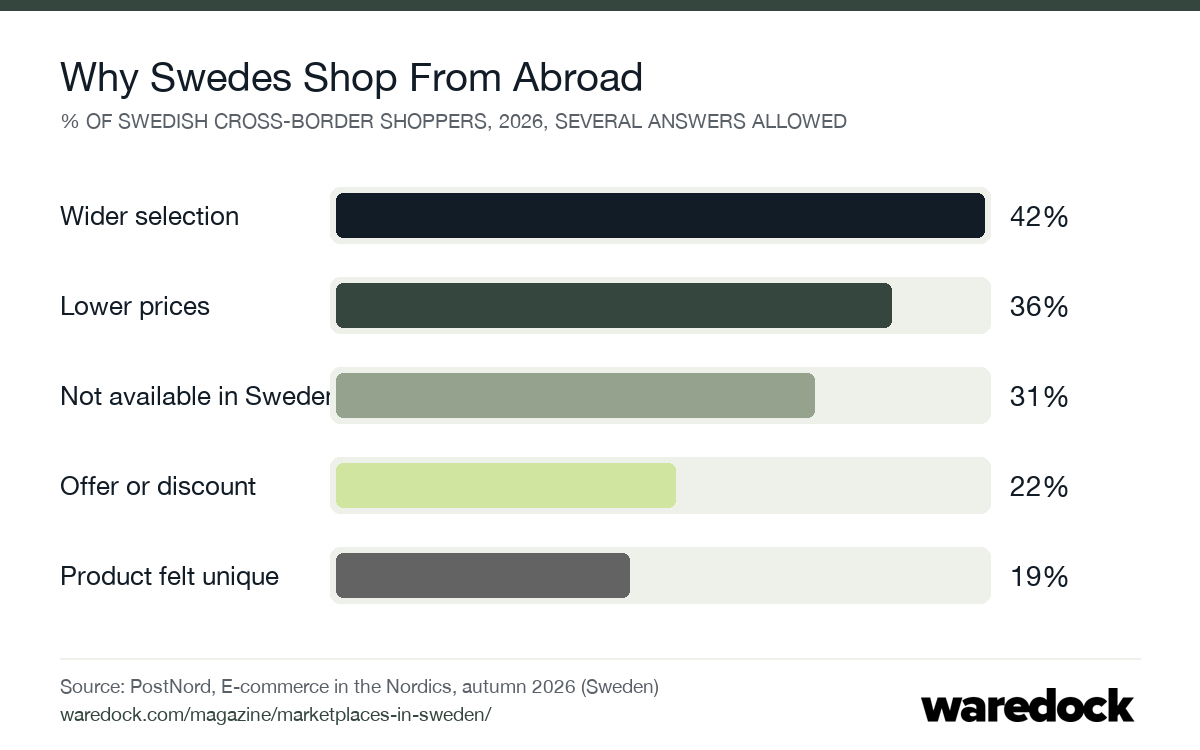
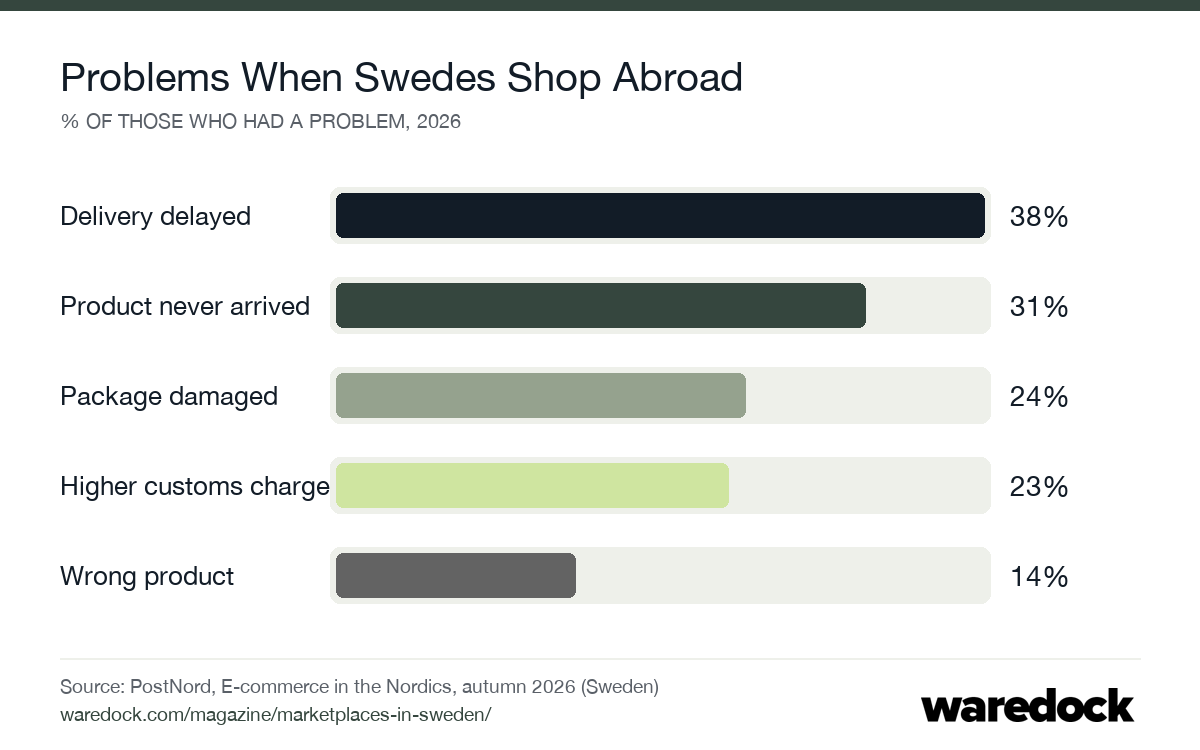
Swedes who shop abroad do it mainly for a wider selection (42%) and lower prices (36%), or because a product isn’t sold in Sweden (31%). Men mostly look for range, women mostly for price. But problems are rising: 18% had an issue with a cross-border order in the past year, up from 16%, and delayed deliveries were the most common complaint. For sellers, that is an opening: stock held in the EU and shipped on time beats a cheaper parcel that arrives late.
Source: PostNord, E-commerce in the Nordics, autumn 2026. Several answers allowed. Source: PostNord, E-commerce in the Nordics, autumn 2026. 18% of Swedes had a problem with a cross-border purchase in the past year.
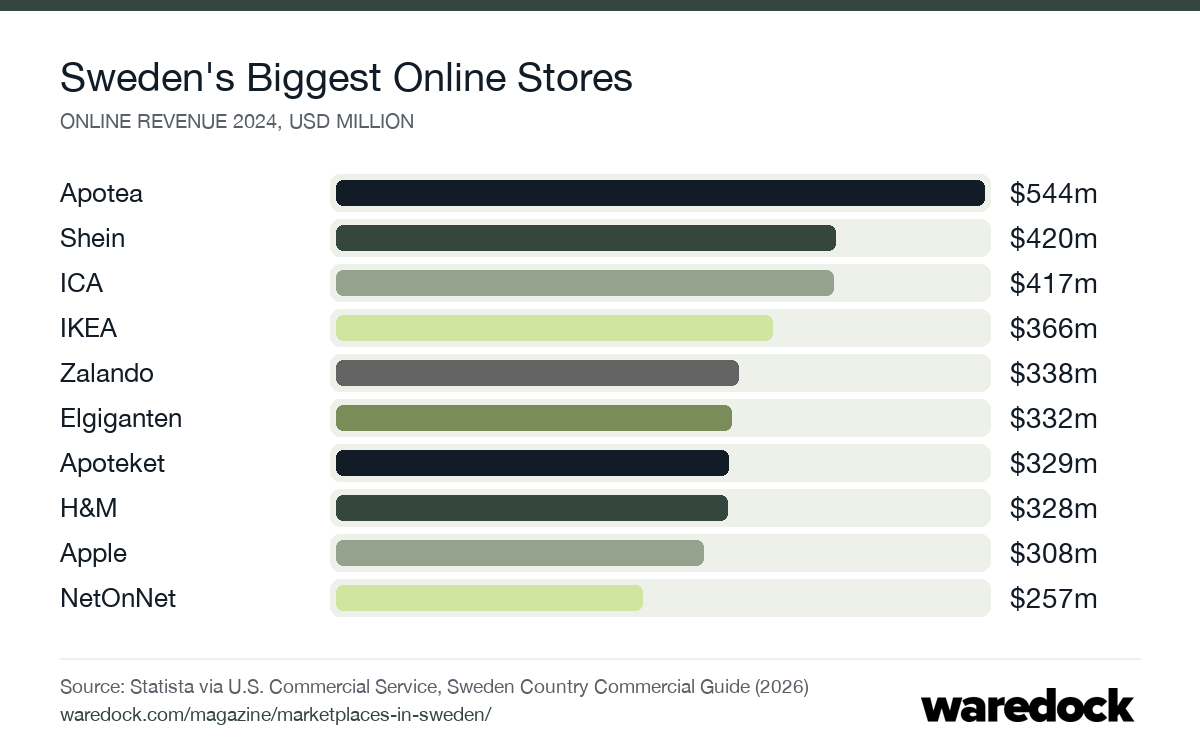
Sweden’s biggest online stores are a mix of pharmacies, grocers, furniture and fashion. Of the top ten by online revenue in 2024, only Zalando and Elgiganten also run open marketplaces, and Shein opened its platform to European sellers in 2023. The rest sell their own stock (see big retailers, not marketplaces).
Source: Statista, via U.S. Commercial Service, Sweden Country Commercial Guide (April 2026).
Top marketplaces in Sweden in 2026 compared
The table lists the marketplaces most relevant to brands selling new goods to Swedish consumers, with fees as published by each marketplace or its integration partners (checked November 2026). Fees change often, so confirm them before you sign up.
| Marketplace | Type | Best for | Seller fees (stated) | Reach beyond Sweden |
|---|---|---|---|---|
| Amazon.se | General marketplace | Most categories, sellers already on Amazon Europe | €39/month Professional plan + referral fee by category | All Amazon EU stores |
| Zalando | Fashion platform, own stock + partners | Fashion, shoes, sports, beauty | Commission agreed in the Partner Programme contract | 25+ European markets |
| CDON | Nordic marketplace, third-party only | Electronics, home, toys, multi-category | Monthly fee + commission by category | Finland, Denmark, Norway |
| Fyndiq | Nordic deals marketplace | Value ranges, promotions, excess stock | 12.5% commission + SEK 10 per item; monthly fee SEK 449 | Finland, Denmark, Norway |
| Elgiganten Marketplace | Electronics retailer + marketplace | Electronics, appliances, accessories | By application; Nordic company and VAT number required | Elkjøp stores in Norway, Denmark, Finland |
| Tradera | Auctions and fixed price, private + business | Second-hand, collectibles, refurbished | About 10% of the final price for private sellers; business terms differ | International buyers |
| Blocket | Classifieds | Local, used and bulky goods | Listing fees | Sweden only |
| Åhléns | Department store + marketplace | Beauty, fashion, home | By application | Sweden |
| Stadium Connect | Sports retailer + marketplace | Sport, outdoor, fitness | By application | Nordic and German Stadium stores |
| Fruugo | Cross-border marketplace | Small pilots across many countries | 20% of your listed price, no monthly fee | 40+ countries |
The top marketplaces in Sweden, one by one
1. Amazon.se
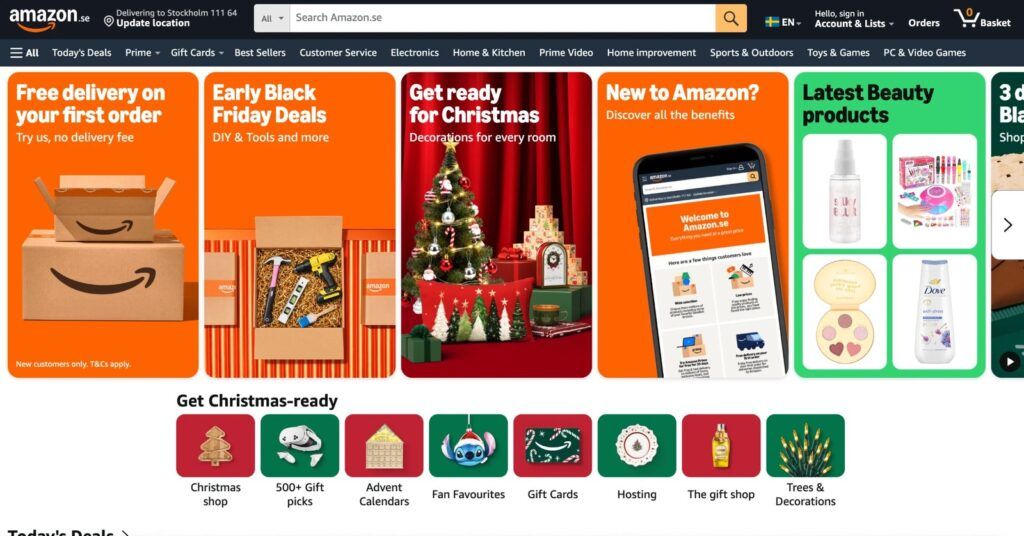
Amazon opened Amazon.se in October 2020, its first store in the Nordics. Five years later it is the most visited retail website in Sweden, with about 12.3 million monthly visits in June 2025, ahead of ICA and Elgiganten (Semrush). Amazon is also the international marketplace Swedes use most: 32% of cross-border shoppers name it, ahead of Zalando (30%) and Temu (28%) (U.S. Commercial Service). Since May 2026, PostNord TPL operates Amazon’s Swedish fulfilment centre in Eskilstuna, about 25,000 m² (PostNord).
- Suits: electronics, home, books, sports, toys and consumer goods; anyone already selling on Amazon in Europe, because one European account covers Amazon.se.
- Fees: €39 a month for the Professional plan plus a referral fee by category; FBA fees on top if Amazon ships for you. See FBA vs FBM in Europe.
- Watch out for: Swedish-language listings convert much better than English or German ones, and storing stock in Sweden through Pan-European FBA means registering for Swedish VAT.
2. Zalando
Zalando runs a fully localised Swedish store at zalando.se and was Sweden’s fifth-largest online store in 2024, with about USD 338 million in online revenue (Statista, via the U.S. Commercial Service). The group grew revenue 16.8% to €12.3 billion in 2025 on €17.6 billion of gross merchandise volume and reached 62 million active customers after taking over ABOUT YOU in July 2025 (Zalando annual report 2025). PostNord TPL runs a 50,000 m² Nordic central warehouse for Zalando in Brunna, north of Stockholm.
- Suits: fashion, footwear, sportswear, accessories and beauty in the mid to premium range.
- How to sell: apply to the Zalando Partner Programme and ship from your own warehouse or 3PL, or use Zalando Fulfilment Solutions.
- Watch out for: Swedish shoppers return fashion often, so plan returns and restocking, and give accurate size information.
3. CDON
CDON was founded in Malmö in 1999 and is the Nordic region’s best-known pure marketplace, active in Sweden, Finland, Denmark and Norway. In 2026 it completed its exit from selling its own stock, so it now hosts only third-party sellers. CDON Group, which also owns Fyndiq, had about 3 million active customers, 3,000 active merchants and 30 million products in Q2 2026. Group GMV rose 6% to SEK 1.93 billion in 2025, with SEK 1.39 billion from CDON (CDON year-end report 2025).
- Suits: electronics, home and kitchen, toys, games, sports and beauty sellers who want four Nordic countries from one account.
- Fees: a monthly fee plus commission by category. CDON’s take rate (its revenue as a share of sales) was 12.8% in Q2 2026; check the current price list before you join.
- Watch out for: Norway is outside the EU, so Norwegian sales need VOEC registration and customs.
4. Fyndiq
Fyndiq is Sweden’s deals marketplace, founded in Stockholm in 2010 and part of CDON Group since 2023. It is the group’s fastest-growing part: GMV rose 30% to SEK 157 million in Q2 2026. Fyndiq handles marketing, customer service and payments for sellers.
- Suits: value ranges, promotional lines, accessories, home goods, toys and excess stock.
- Fees: 12.5% commission on the price excluding VAT plus a SEK 10 category fee per item sold in Sweden; the monthly fee rose to SEK 449 on 1 August 2026 (integration partner e-tailize).
- Watch out for: buyers are price-driven, so margins are thin. List only stock you can ship immediately, with honest delivery times.
5. Elgiganten Marketplace
Elgiganten is Sweden’s largest electronics chain and part of the Elkjøp Group, owned by the UK’s Currys. Its marketplace lets approved partners sell alongside Elgiganten’s own range; across the group’s four Nordic countries it has about 240 sellers and 200,000 offers (Mirakl). Elgiganten was Sweden’s sixth-largest online store in 2024, with about USD 332 million in online revenue.
- Suits: electronics brands, accessories, small appliances and gaming.
- How to sell: apply through Elgiganten’s partner page. Integration partners say you need a company registered in Sweden, Denmark, Norway or Finland with a VAT number, and a structured product feed.
- Watch out for: you sell next to Elgiganten’s own stock, so price and delivery time decide who wins the sale.
6. Tradera
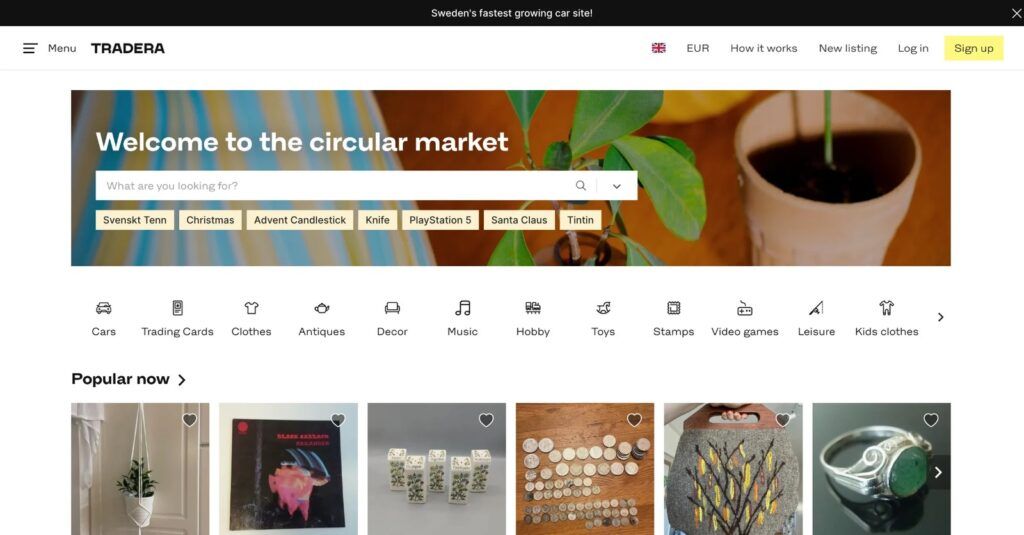
Tradera is Sweden’s auction and second-hand marketplace, founded in 1999, owned by eBay from 2006, then by PayPal, and Swedish-owned again since 2021. It has about 3.6 million members and earned €56.7 million in revenue in 2025. Both private and business sellers use it, with auctions and fixed-price listings. Brands such as Gina Tricot and Adoore sell pre-loved items through Tradera, and in Q2 2026 it opened its platform to AI shopping agents through an AI-ready API (E-barometern Q2 2026). In PostNord’s autumn 2026 survey, Vinted overtook Tradera as Swedes’ most popular second-hand marketplace.
- Suits: second-hand, refurbished and vintage goods, collectibles, returns and outlet stock.
- Fees: private sellers pay about 10% of the final price (minimum SEK 3, maximum SEK 200); business sellers have separate terms.
- Watch out for: Swedish is the main language, and buyers expect quick shipping to a service point or parcel locker.
7. Blocket
Blocket is Sweden’s biggest classifieds site, founded in Skåne in 1996 and owned by Schibsted since 2003. In 2021 Blocket reported that 7 in 10 Swedes had bought or sold something there, with about 5 million unique visitors a week. It is mostly consumer-to-consumer, but companies list cars, furniture, electronics and outlet goods too.
- Suits: local, bulky and second-hand goods, and brands clearing returns or outlet stock.
- Watch out for: Blocket is a listing site, not a catalogue marketplace, so it doesn’t take product feeds the way CDON or Amazon do.
8. Åhléns
Åhléns is a Swedish department store chain that also runs an online marketplace for outside sellers in beauty, fashion and home. Åhléns sells its own stock alongside partners and doesn’t offer fulfilment services to them, so you ship marketplace orders yourself or through a 3PL (ChannelEngine).
- Suits: beauty, fragrance, fashion accessories and home décor brands that fit a department-store range.
- Watch out for: approval comes first, and range fit matters more than catalogue size.
9. Stadium Connect
Stadium, the Nordic sports retailer, launched its marketplace Stadium Connect in 2021 with brands such as Craft, Casall and Didriksons, and added Mirakl Ads retail media in 2025 (Mirakl, SGI Europe).
- Suits: sport, outdoor, fitness and active lifestyle brands.
- Watch out for: Stadium curates its range, so expect an application process and brand checks.
10. Fruugo
Fruugo is a cross-border marketplace founded in Finland and now run from the UK. You upload one feed and Fruugo translates listings, converts prices and handles customer service, including in Sweden. Since 1 January 2026 it charges a single 20% fee on your listed price. Be careful: Fruugo’s 2024 accounts, filed in December 2025, show transaction volume down from £207 million to £133 million, turnover down about 29% to £56 million, an operating loss of £10.8 million, and the directors flag a material uncertainty about the group’s ability to continue as a going concern (ChannelX).
- Suits: small cross-border pilots with a limited range.
- Watch out for: confirm payout terms before you list meaningful volume, and don’t make Fruugo a core channel until its next accounts show a recovery.
Challengers and start-ups to watch
Sweden’s marketplace scene keeps moving. These platforms are either growing fast in Sweden or new enough that early sellers can still stand out.
Temu, Shein and AliExpress
Temu has overtaken Zalando as Swedes’ second most favoured international marketplace (PostNord, spring 2026), and Shein was Sweden’s second-largest online store in 2024 with about USD 420 million in revenue. Shein opened its platform to European sellers in 2023, and Temu runs a local-seller programme in some EU markets. For most European brands, these are competitors and price benchmarks rather than channels. From 1 July 2026 the EU charges a flat €3 customs duty per item on low-value parcels from outside the EU, which narrows the gap for sellers who hold stock in the EU (see the €3 EU duty explained and Temu alternatives in Europe).
Brand resale: IKEA, Gina Tricot and others
Swedish retailers are adding second-hand to their own business. IKEA launched its own marketplace for used IKEA products in early 2026, Kappahl bought the resale company Arkivet, and Gina Tricot and Adoore sell pre-loved items through Tradera instead of building their own platforms (E-barometern Q2 2026). For brands, resale is becoming a channel in its own right, with its own returns, grading and logistics flows.
OnBuy
The UK marketplace OnBuy launched across the Nordics, including Sweden, in June 2026, backed by Posten Bring. It doesn’t sell products itself, so it never competes with its sellers, and it reported 152% quarterly GMV growth across its first twelve European markets in 2025. Swedish buyers don’t know it well yet, so treat it as an extra channel.
Sellpy
Sellpy is a Stockholm resale platform majority-owned by H&M Group (about 70%). Sellers send in bags of clothes and Sellpy photographs, prices and ships them. It is available in 24 markets and sells far more than H&M brands. Resale made up 0.8% of H&M Group turnover in 2025, up 31% on 2024.
Vinted, Plick and Bought
Plick is a Swedish app for second-hand fashion with buyers and sellers in Sweden and Finland, and Schibsted, the owner of Blocket, is a major shareholder. Vinted, Europe’s largest second-hand fashion marketplace, is now Swedes’ most popular online second-hand marketplace, especially with younger shoppers, having overtaken Tradera in 2026, while Tradera, Facebook Marketplace and Sellpy lost ground (PostNord, autumn 2026). Vinted members traded €10.8 billion across its markets in 2025. Bought, a Finnish resale app, announced plans to expand into Sweden in late 2025. For brands, these platforms are where your products get a second life, and a growing reason to offer take-back or resale programmes.
Sweden’s biggest online stores are mostly retailers
Many of the largest online stores in Sweden don’t take open marketplace listings. To sell through them, you become a supplier: pitch the category buyer, agree wholesale terms and deliver to their warehouses.
- Apotea and Apoteket: online pharmacies with large beauty and health ranges; Apotea was Sweden’s largest online store in 2024.
- ICA and Coop: grocery leaders driving growth in food eCommerce.
- IKEA and H&M: global Swedish brands selling their own ranges online.
- NetOnNet and Webhallen: electronics retailers competing with Elgiganten.
- Boozt, Lyko, Adlibris and Clas Ohlson: online leaders in fashion, beauty, books and DIY.
Supplying these retailers needs B2B fulfilment alongside parcel shipping: retailer labels, advance shipping notices and delivery booking. See B2B and retail fulfilment.
Who should sell where in Sweden?
| Your business | Start with | Add next |
|---|---|---|
| Any category, already on Amazon Europe | Amazon.se | CDON for the rest of the Nordics |
| Fashion, shoes and sportswear brand | Zalando | Stadium Connect (sport), your own Swedish webshop |
| Electronics and accessories | Elgiganten Marketplace | CDON, Amazon.se |
| Multi-category Nordic seller | CDON | Fyndiq (same group) |
| Value ranges and excess stock | Fyndiq | Tradera or Blocket for outlet stock |
| Beauty and home brands | Åhléns | Amazon.se, Zalando Beauty |
| Second-hand, refurbished or collectibles | Tradera | Blocket, Sellpy (fashion) |
| Supplier to Swedish retail chains | Wholesale to Apotea, ICA, NetOnNet or others | Marketplaces for direct-to-consumer sales |
What Swedish buyers expect
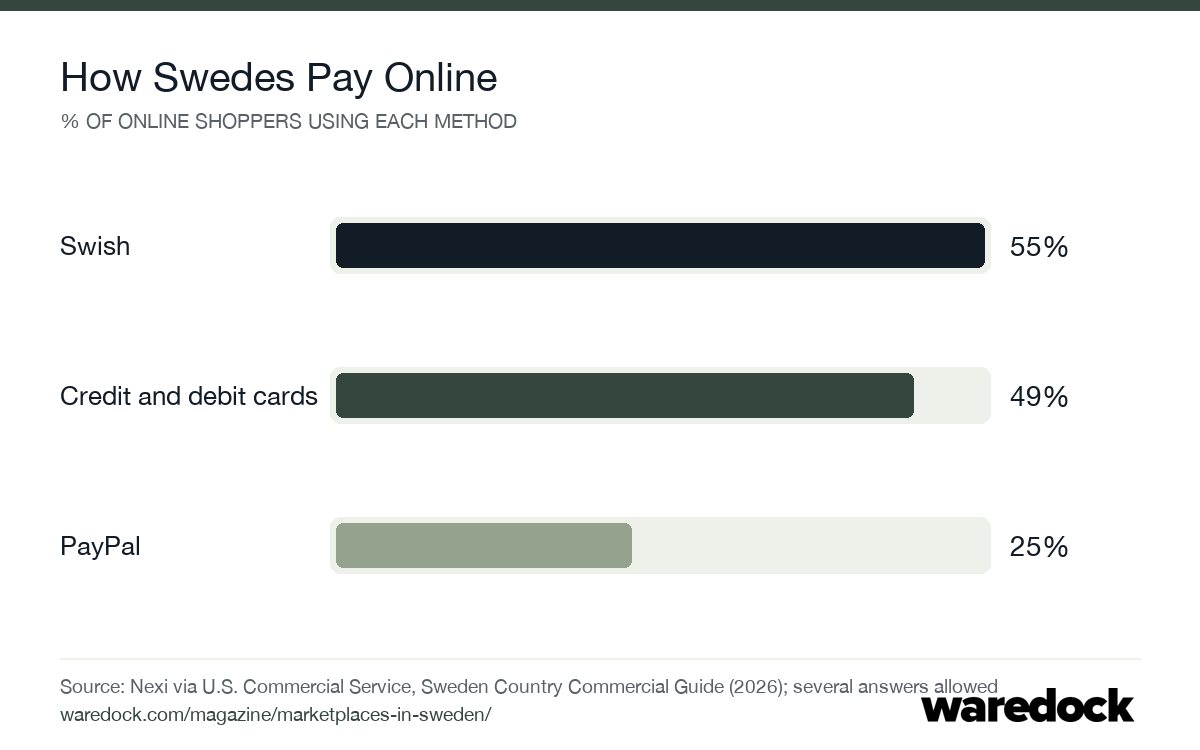
- Swish and Klarna at checkout. 55% of Swedes use Swish, the mobile payment app run by Swedish banks, 49% use cards and 25% PayPal (Nexi). Invoice and pay-later options from Klarna, founded in Stockholm in 2005, are also deeply rooted. Marketplaces handle payment for you; your own webshop should offer Swish and an invoice option.
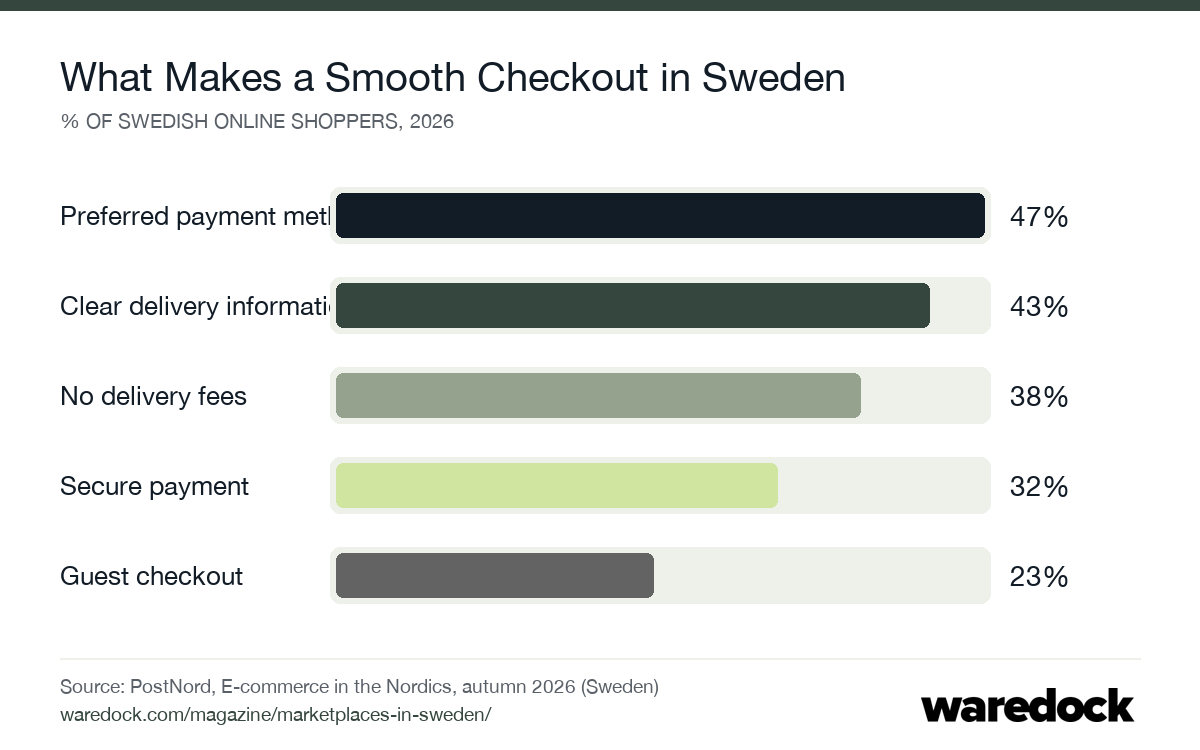
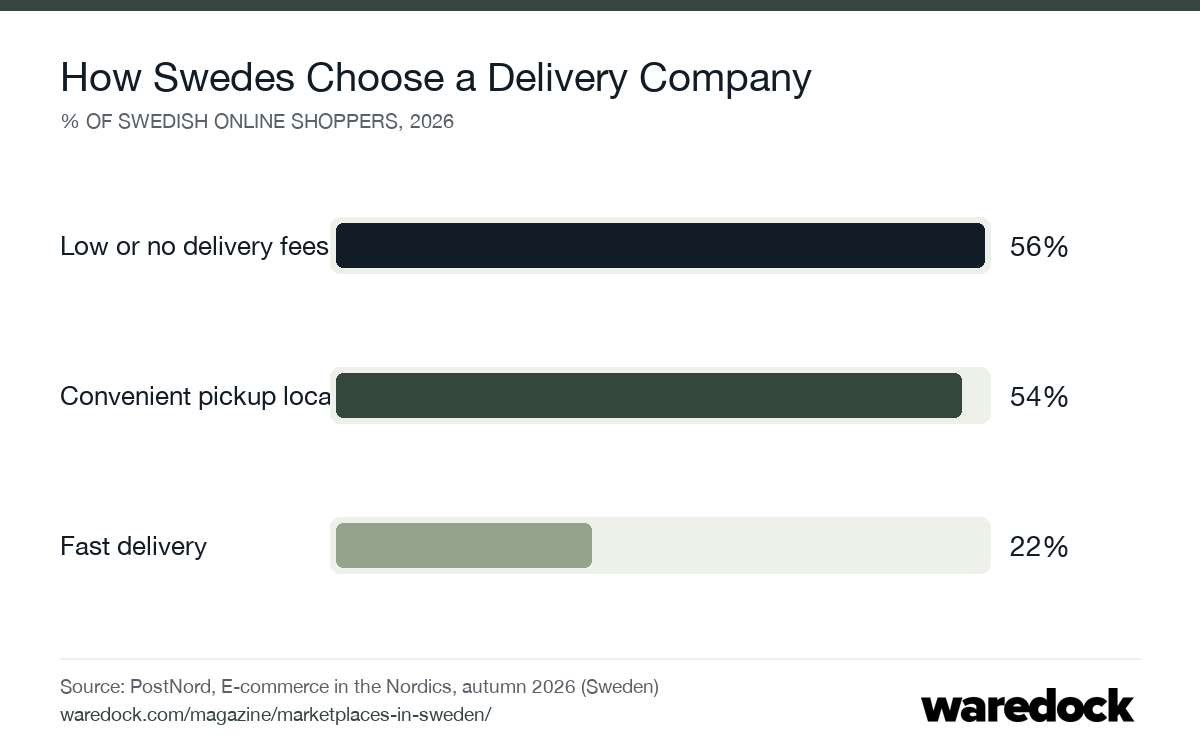
- A smooth checkout. 84% of Swedes were satisfied with checkout on their latest purchase, down from 86%. Being able to pay their preferred way matters most (47%), followed by clear delivery information (43%) and no delivery fees (38%). When choosing a delivery company, low or no fees (56%) and convenient pickup points (54%) count far more than speed (22%) (PostNord, autumn 2026).
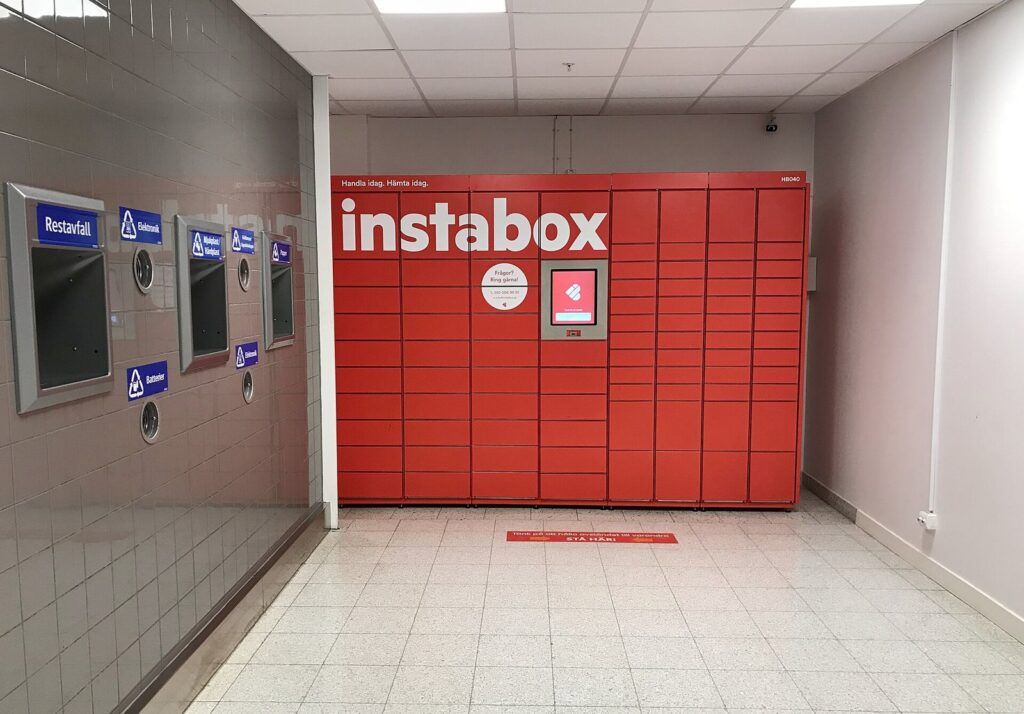
- Delivery choice. Home delivery is the most used and preferred option in Sweden, and parcel lockers have overtaken service points as the second most preferred (PostNord, spring 2026). Lockers rose from 3% of deliveries in 2020 to 19% in Q2 2026.
- Easy returns. Swedes expect a simple, free or cheap return to a service point or locker, especially for fashion.
- Swedish content and prices in SEK. Listings in Swedish convert far better than English ones, and Sweden uses the krona, not the euro.
- Mobile-first listings. Smartphones account for 58% of Swedish online purchases (Mordor Intelligence).
Source: Nexi, via U.S. Commercial Service, Sweden Country Commercial Guide (April 2026). Shoppers could name several methods. Source: PostNord, E-commerce in the Nordics, autumn 2026. Several answers allowed. Source: PostNord, E-commerce in the Nordics, autumn 2026.
VAT and rules: Sweden’s standard VAT rate is 25%. If your stock is in another EU country, B2C sales to Sweden can usually be reported through the EU One-Stop Shop (OSS) once you pass the €10,000 EU-wide distance-selling threshold; storing stock in Sweden, for example through Amazon FBA, generally means registering for Swedish VAT. Online buyers have a 14-day right of withdrawal. See our guide to EU VAT, OSS and IOSS, and check your case with a tax adviser.
How to ship marketplace orders to Sweden

Most Swedish marketplaces, apart from Amazon FBA and Zalando Fulfilment Solutions, leave delivery to you. You have three main options:
- Ship from Central Europe: simple if your stock is in Germany or the Netherlands, but delivery to northern Sweden takes longer.
- Warehouse in Sweden: fast local delivery, but higher labour and storage costs, and a Swedish VAT registration.
- Warehouse in Estonia: overnight ferries link Tallinn and Stockholm, so parcels reach most of Sweden in two to four days, at lower cost per order, and the same stock serves Finland and the Baltics.
Keep one stock pool for all channels, so the same warehouse ships CDON, Fyndiq, Elgiganten, Åhléns and Tradera orders, Amazon FBM orders and your own webshop.
How Waredock helps: we fulfil Swedish orders from our warehouse in Estonia, with overnight ferry linehaul to Stockholm and delivery to homes, parcel lockers and service points across Sweden, typically in two to four days. One stock serves Sweden, Finland and the Baltics, and B2C sales to Sweden can usually be reported through OSS instead of a Swedish VAT registration. Our team and AI agents work together on every order, so it ships fast and right first time. See fulfilment for Sweden, fulfilment for marketplace sellers and fulfilment companies in the Nordics and Baltics compared.
Selling across the region? See top marketplaces in Denmark, top marketplaces in Finland and our top 30 marketplaces in Europe.
Frequently asked questions
What is the biggest online marketplace in Sweden?
Amazon.se is the most visited retail website in Sweden and the international marketplace Swedes use most. Among Nordic platforms, CDON is the best-known marketplace, Zalando leads in fashion, and Blocket and Tradera lead in second-hand.
Does Amazon have a Swedish website?
Yes. Amazon.se opened in October 2020 and sells in Swedish and kronor. Sellers list on it through their European Amazon seller account.
Which marketplace is best for selling fashion in Sweden?
Zalando, with a localised Swedish store. Stadium Connect suits sports and outdoor brands, Åhléns suits beauty and accessories, and Sellpy, Tradera and Vinted matter for second-hand fashion.
Can I reach all the Nordic countries with one account?
Yes. CDON and Fyndiq each cover Sweden, Finland, Denmark and Norway from one seller account. Norway is outside the EU, so it needs VOEC registration and customs.
Do I need a Swedish company or VAT number to sell on Swedish marketplaces?
It depends on the marketplace. Elgiganten asks for a Nordic-registered company with a VAT number; Amazon.se, CDON and Fyndiq accept EU sellers. For VAT, stock held in another EU country can usually be reported through OSS, while stock stored in Sweden needs a Swedish VAT registration. The standard rate is 25%.
How do Swedes prefer to pay online?
Swish (55%) and cards (49%) are the most used methods, followed by PayPal (25%). Invoice and pay-later payments through Klarna are also common.
Method: marketplace facts and fees come from each company’s own website, reports or official integration partners, checked November 2026. Market data comes from the sources below. This guide doesn’t rank marketplaces by quality; the order reflects relevance for brands selling new goods to Swedish consumers.
Sources
- PostNord – E-barometern 2025 annual report
- Svensk Handel – E-handeln ökade under 2025 (19 February 2026)
- PostNord – E-commerce in the Nordics, autumn 2026 (report and Sweden chapter)
- PostNord – Cross-border shopping and marketplaces in Sweden, spring 2026
- PostNord – E-commerce delivery trends in Sweden, spring 2026
- PostNord and HUI Research – E-barometern Q2 2026 (report PDF)
- nShift – Swedish e-commerce trends, PostNord E-barometern Q2 2026
- U.S. Commercial Service – Sweden Country Commercial Guide: eCommerce (April 2026)
- Mordor Intelligence – Sweden E-commerce Market (2026)
- Semrush – Top retail websites in Sweden
- Zalando SE – Annual Report 2025
- CDON – Q4 and full-year report 2025 (13 February 2026)
- Investing.com – CDON Q2 2026 presentation
- e-tailize – Selling on Fyndiq (fees), checked November 2026
- Elgiganten – Become a Marketplace Partner
- Mirakl – Marketplace and dropship in the Nordic region
- ChannelEngine – Sell on Åhléns
- SGI Europe – Stadium has launched its marketplace
- ChannelX – Fruugo sales plummet in latest accounts (January 2026)
- OnBuy – Nordic expansion with Posten Bring investment (25 June 2026)
- H&M Group – Sellpy
- Schibsted – Investment in Plick
- FashionUnited – Bought app expansion (December 2025)
- Tech.eu – Vinted’s revenues top €1bn (9 April 2026)
- Wikipedia – Tradera, Blocket, CDON, Klarna, Swish
- Skatteverket – VAT rates
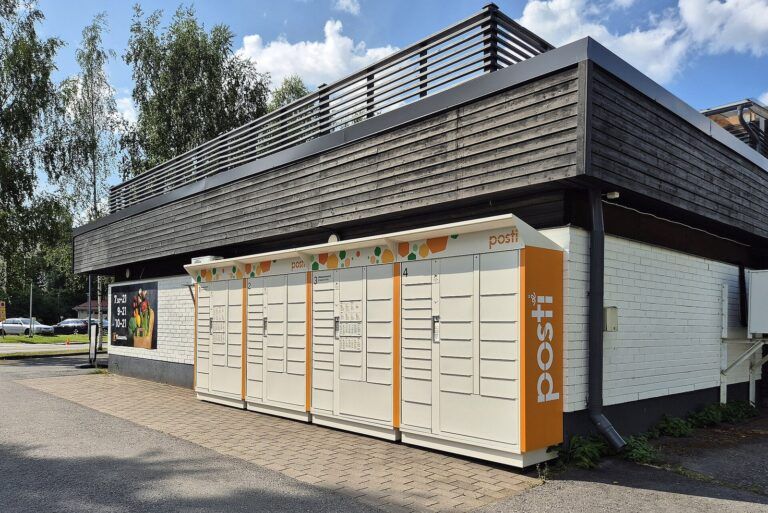
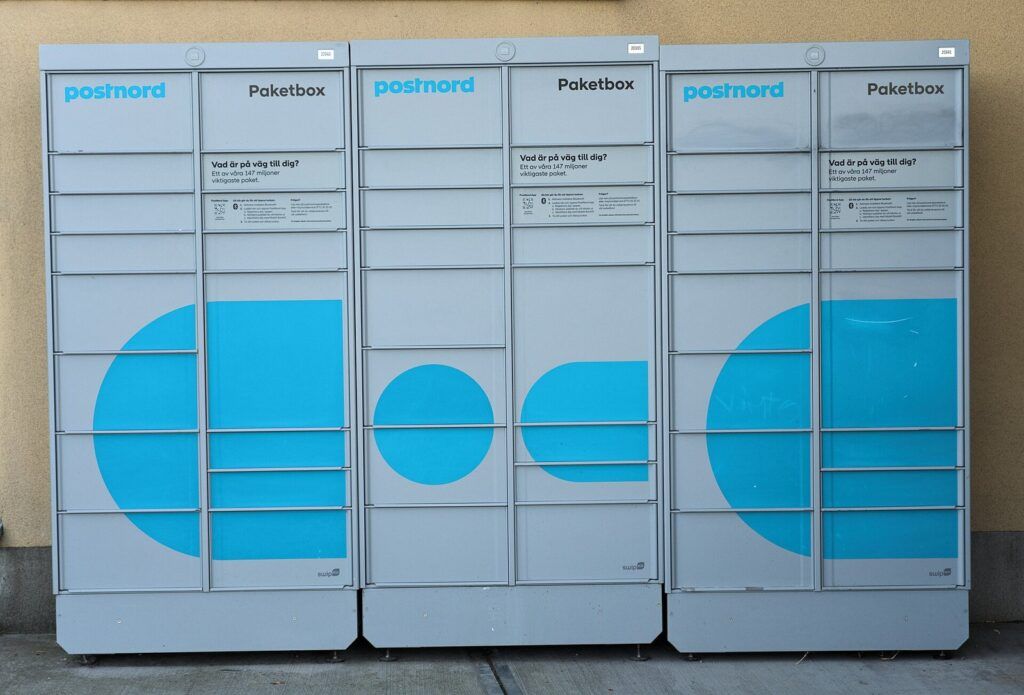
- Cover photo: PostNord parcel lockers by ThibautRe, CC BY-SA 4.0, via Wikimedia Commons