


Denmark is small, rich and extremely online: 92% of Danes bought something online in 2024, the highest share in the EU, and they spent almost DKK 200 billion online in 2025. Denmark has no Amazon store of its own, its biggest webshops are retailers, and Danes buy from abroad more than anyone else in the Nordics. This guide ranks the top marketplaces in Denmark in 2026, explains who each one suits and what it costs, and shows how to get orders to Danish buyers.
Quick answer: The marketplaces that matter most for sellers in Denmark in 2026 are Zalando (fashion), Amazon.de (no Danish store, but the second most visited marketplace site in Denmark), CDON and Fyndiq (Nordic marketplaces), Elgiganten Marketplace (electronics), Miinto (Danish-founded fashion marketplace) and, for second-hand, Vinted, Facebook Marketplace and DBA. 86% of Danes bought from a foreign webshop in the past year, the most in the Nordics, and China’s share of their latest cross-border purchase fell from 29% in 2024 to 16% in 2026 (PostNord, autumn 2026).
Jump to: Market at a glance · Cross-border · Marketplaces compared · The top marketplaces · Second-hand · Big retailers, not marketplaces · Who should sell where · What Danish buyers expect · Shipping to Denmark · FAQ
The Danish eCommerce market at a glance
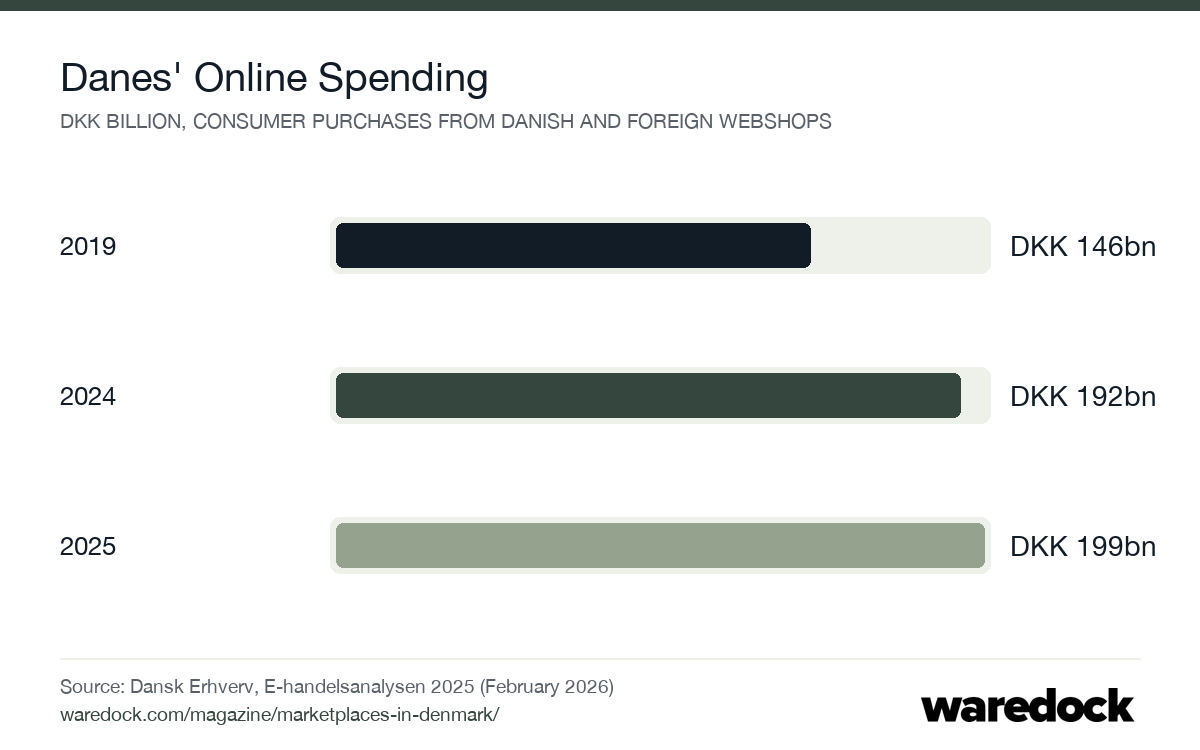
Danish consumers spent DKK 199.2 billion online in 2025, up 3.8% on 2024 and about 37% more than in 2019, according to Dansk Erhverv (the Danish Chamber of Commerce). Growth continued in the first half of 2026, when spending rose 4.2% and passed DKK 100 billion for a half-year for the first time. Other sources measure differently: Dansk Industri’s tracker puts 2025 at DKK 136 billion, and the U.S. Commercial Service estimates the whole market, including B2B, at about USD 28 billion in 2025.
Source: Dansk Erhverv, E-handelsanalysen 2025 (February 2026). 2024 calculated from the reported 3.8% growth.
What the numbers mean for sellers:
- Almost everyone buys online. 92% of Danes aged 16–89 bought online in 2024, the highest share in the EU, and 82% shopped online in the past 30 days (U.S. Commercial Service; PostNord, autumn 2026).
- Mobile first. 55% of online purchases were made on a smartphone in 2025, up from 27% in 2019 (Dansk Erhverv).
- The big get bigger. The 20 largest webshops hold 32% of the Danish market, up from 26% in 2019. Marketplaces and big retailers are where the volume is.
- Price matters less than you think. Only a quarter of Danes name price as the deciding factor; range and convenience matter more (Dansk Erhverv).
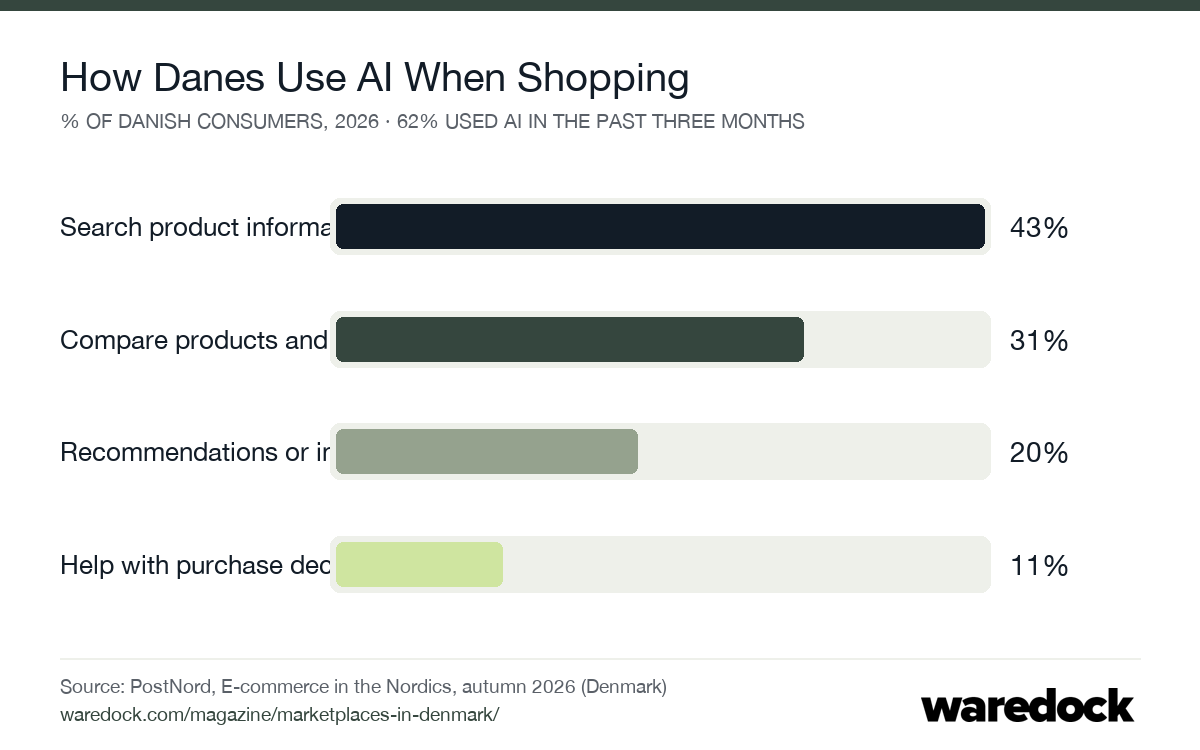
- AI is already in the journey. 62% of Danes used AI when shopping for physical products in the past three months: 79% of 18–29-year-olds and 39% of 65–79-year-olds (PostNord, autumn 2026).
Danes shop abroad more than anyone in the Nordics
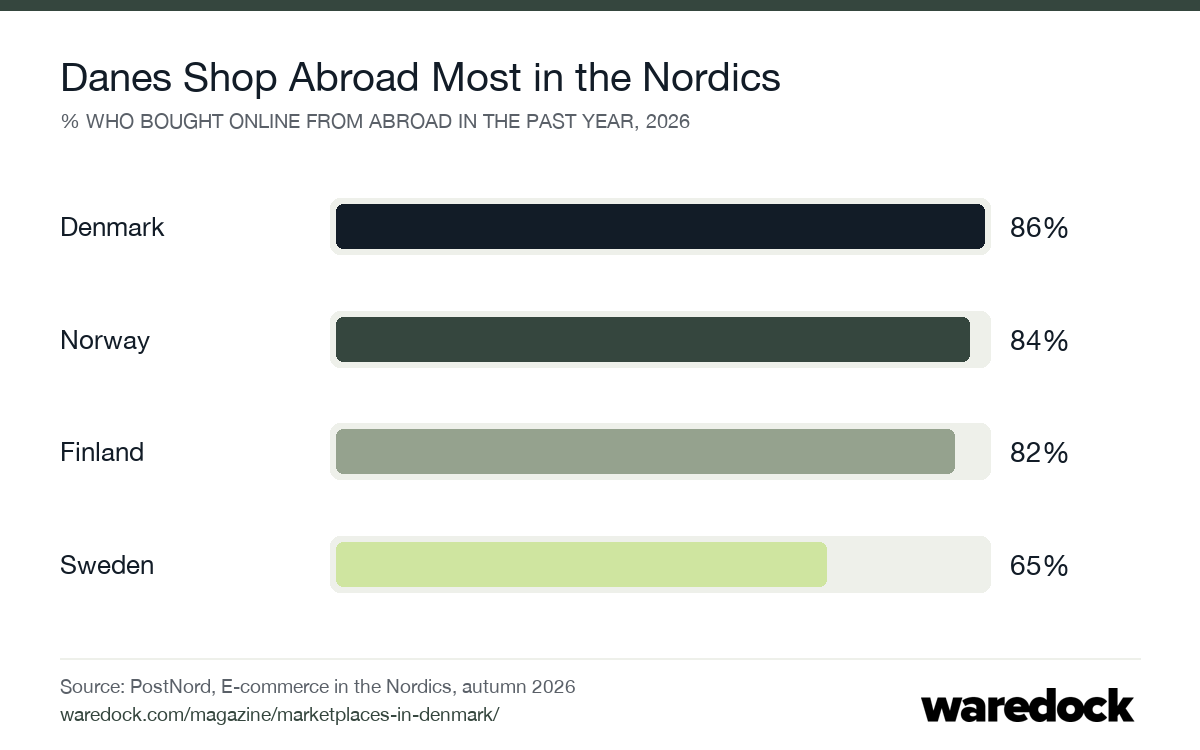
This is where Denmark stands out. 86% of Danes bought online from abroad in the past year, up from 82%, ahead of Norway (84%), Finland (82%) and Sweden (65%). More than half of cross-border shoppers aged 18–29 buy abroad at least once a month (PostNord, autumn 2026). Dansk Erhverv’s data points the same way: Germany accounts for 24% of Danes’ purchases from foreign webshops, Sweden 21% and China 18%.
Source: PostNord, E-commerce in the Nordics, autumn 2026.
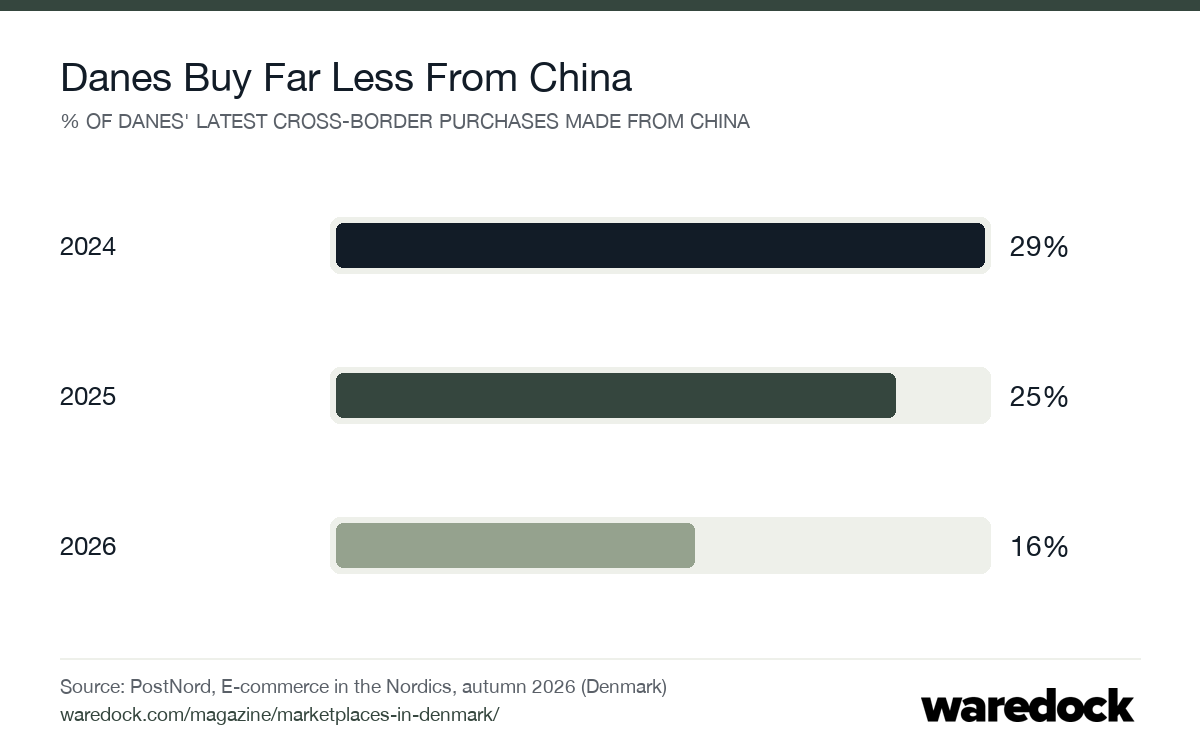
The second big story is the shift away from China. Germany (25%) and Sweden (19%) now lead as the countries of Danes’ latest cross-border purchase, while China’s share has nearly halved since 2024, from 29% to 16%. PostNord links this to concerns about product safety and quality on Temu and Shein and to the new EU customs rules for low-value parcels, including the flat €3 duty per item from 1 July 2026 (see the €3 EU duty explained). For European brands, nearby stock and fast delivery are winning back buyers.
Source: PostNord, E-commerce in the Nordics, autumn 2026. In 2026 Germany (25%) and Sweden (19%) led instead.
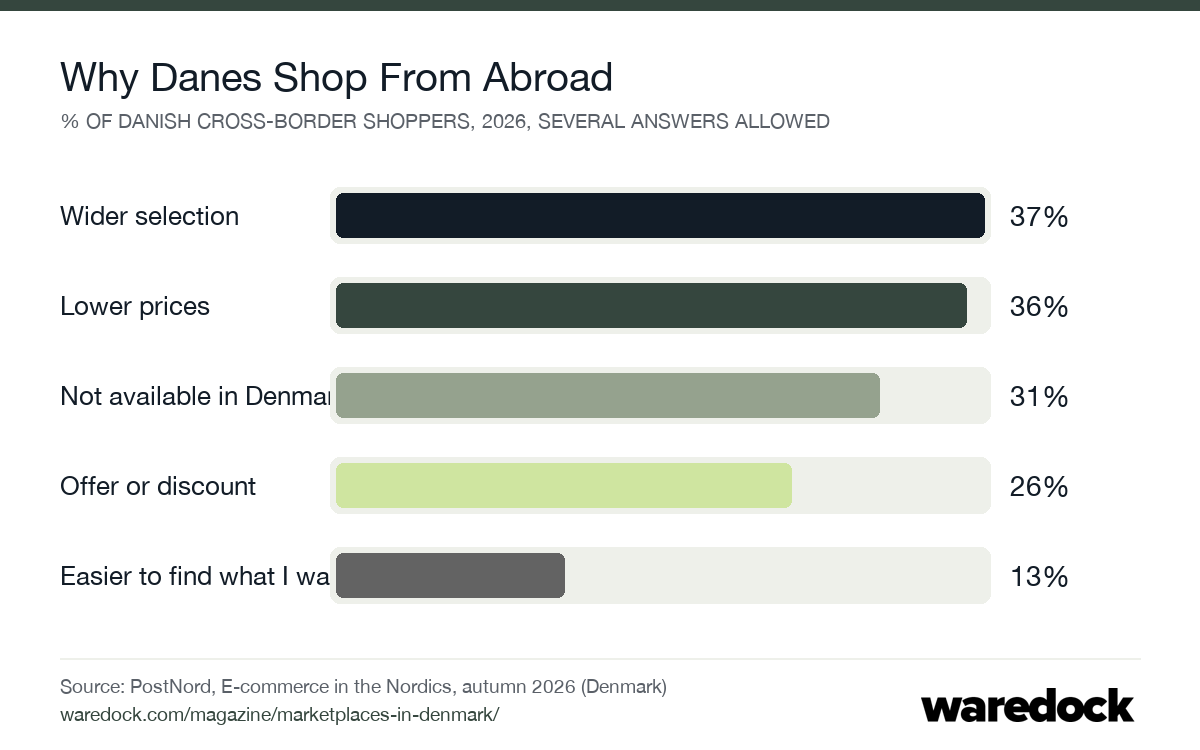
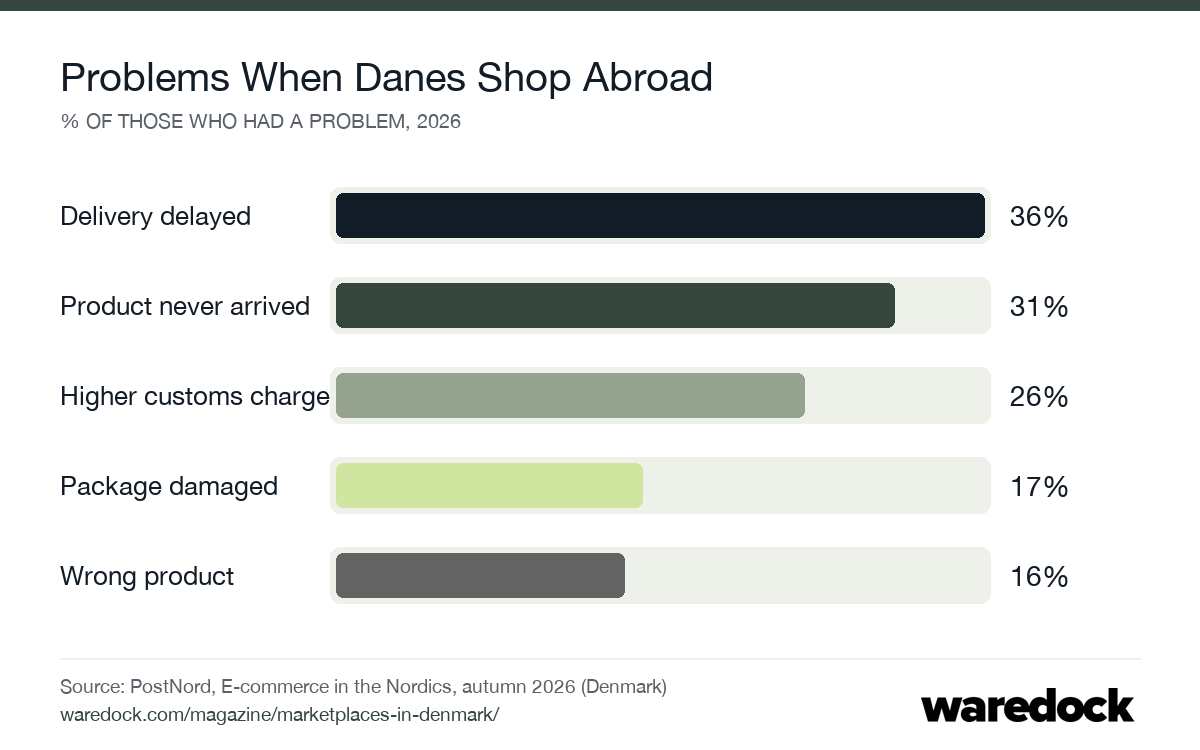
Danes buy abroad for a wider selection (37%), lower prices (36%) and products they can’t get in Denmark (31%). Fewer had problems with foreign orders in 2026, 15% against 25% a year earlier, but delays, missing parcels and unexpected customs charges remain the main complaints. Clear delivery times and all-in prices are what win Danish cross-border buyers.
Source: PostNord, E-commerce in the Nordics, autumn 2026. Several answers allowed. Source: PostNord, E-commerce in the Nordics, autumn 2026. 15% of Danes had a problem with a cross-border purchase in the past year (25% in 2025).
Top marketplaces in Denmark in 2026 compared
The table lists the marketplaces most relevant to brands selling new goods to Danish consumers, with fees as published by each marketplace or its integration partners (checked November 2026). Fees change often, so confirm them before you sign up.
| Marketplace | Type | Best for | Seller fees (stated) | Reach beyond Denmark |
|---|---|---|---|---|
| Zalando | Fashion platform, own stock + partners | Fashion, shoes, sports, beauty | Commission agreed in the Partner Programme contract | 25+ European markets |
| Amazon.de | General marketplace, Danish-language option | Sellers already on Amazon Europe | €39/month Professional plan + referral fee by category | All Amazon EU stores |
| CDON | Nordic marketplace, third-party only | Electronics, home, toys, multi-category | Monthly fee + commission by category | Sweden, Finland, Norway |
| Fyndiq | Nordic deals marketplace | Value ranges, promotions, excess stock | 12.5% commission + DKK 8 per item; monthly fee about €39 | Sweden, Finland, Norway |
| Elgiganten Marketplace | Electronics retailer + marketplace | Electronics, appliances, accessories | By application; Nordic company and VAT number required | Elkjøp stores in Sweden, Norway, Finland |
| Miinto | Fashion marketplace, third-party only | Fashion brands and boutiques | Commission by agreement | Scandinavia and other European markets |
| Vinted, DBA, Facebook Marketplace | Second-hand, mostly consumer-to-consumer | Pre-owned, local and outlet goods | Vinted: no seller fees; DBA: listing fees | Vinted: 20+ markets; DBA: Denmark |
| OnBuy | General marketplace, third-party only | Early movers looking for an Amazon alternative | Subscription + commission | 20+ European markets |
The top marketplaces in Denmark, one by one
1. Zalando
Zalando is the leading fashion platform for Danish online shoppers, with a fully localised store at zalando.dk; the U.S. Commercial Service describes it as dominant in Danish online fashion, the country’s largest online category. The group grew revenue 16.8% to €12.3 billion in 2025 on €17.6 billion of gross merchandise volume and reached 62 million active customers after taking over ABOUT YOU (Zalando annual report 2025).
- Suits: fashion, footwear, sportswear, accessories and beauty in the mid to premium range.
- How to sell: apply to the Zalando Partner Programme and ship from your own warehouse or 3PL, or use Zalando Fulfilment Solutions.
- Watch out for: fashion returns. Plan returns handling and restocking before you launch.
2. Amazon (via Amazon.de)
There is no amazon.dk. Danes shop on Amazon.de, which Amazon opened in Danish in November 2023 with a selection of products popular in Denmark (Dansk Erhverv). In October 2026 amazon.de was the second most visited marketplace website in Denmark, after the DIY chain Jem & Fix (Similarweb).
- Suits: sellers already on Amazon in Europe; one European account covers Amazon.de and reaches Danish buyers.
- Fees: €39 a month for the Professional plan plus a referral fee by category; FBA fees on top. See FBA vs FBM in Europe.
- Watch out for: deliveries from Germany to Denmark take longer than domestic ones, and Danish shoppers rank delivery information and pickup points highly.
3. CDON
CDON is the Nordic region’s best-known pure marketplace, founded in Sweden in 1999 and active in Denmark, Sweden, Finland and Norway. It finished phasing out its own stock in 2026, so it now hosts only third-party sellers. CDON Group, which also owns Fyndiq, had about 3 million active customers and 3,000 merchants in Q2 2026.
- Suits: electronics, home and kitchen, toys, games, sports and beauty sellers who want the four Nordic countries from one account.
- Fees: a monthly fee plus commission by category; check CDON’s current price list.
- Watch out for: Danish-language listings convert better, and Norway needs VOEC registration and customs.
4. Fyndiq
Fyndiq is the Nordic deals marketplace from CDON Group, with a Danish store at fyndiq.dk. It is the group’s fastest-growing part: GMV rose 30% in Q2 2026.
- Suits: value ranges, promotional lines and excess stock.
- Fees: 12.5% commission on the price excluding VAT plus a DKK 8 category fee per item sold in Denmark; the monthly fee rose to SEK 449 (about €39) on 1 August 2026 (integration partner e-tailize).
- Watch out for: buyers are price-driven, and older Danes in particular wait for sales: 66% of 65–79-year-olds wait for a promotion before buying (PostNord, autumn 2026).
5. Elgiganten Marketplace
Elgiganten is Denmark’s best-known electronics chain and part of the Elkjøp Group, owned by Currys. Its marketplace lets approved partners sell next to Elgiganten’s own range; across the group’s four Nordic countries it has about 240 sellers and 200,000 offers (Mirakl). Elgiganten is also named among the leading players in Danish eCommerce by Mordor Intelligence.
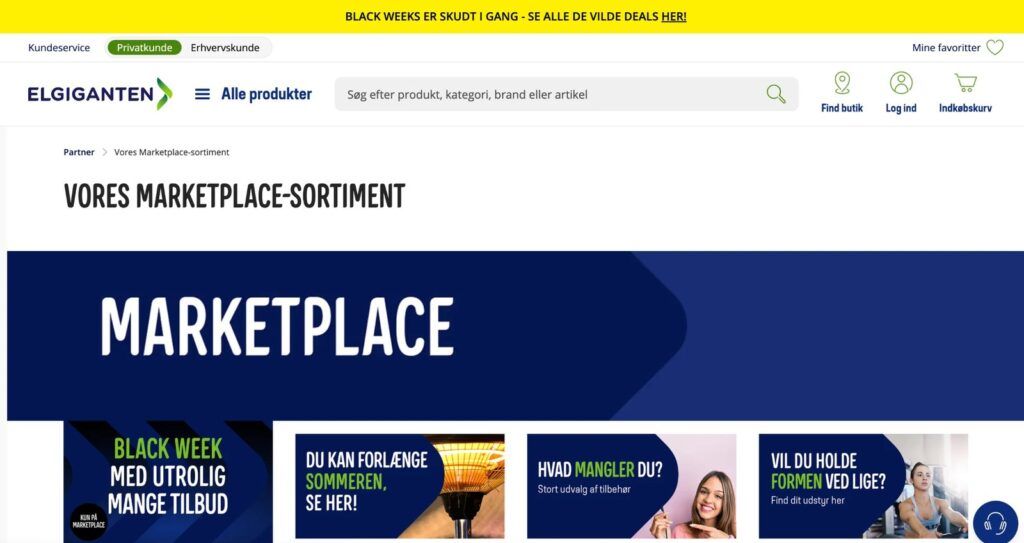
- Suits: electronics brands, accessories, small appliances and gaming.
- How to sell: apply through Elgiganten’s partner page; integration partners say you need a company registered in a Nordic country with a VAT number.
6. Miinto
Miinto is a Copenhagen-founded fashion marketplace that sells only for third parties: boutiques and brands list their stock, and Miinto runs the storefront across Scandinavia and other European markets. Revenue grew 86% to DKK 869 million in the 2024/25 financial year, with an average order of DKK 2,167, and Miinto aims for a positive operating result in 2025/26 (Dansk Online Tidende). It has also bought The Vintage Bar to add pre-owned luxury.
- Suits: premium and contemporary fashion brands and multi-brand boutiques.
- Watch out for: Miinto curates its sellers, and fashion returns need a reliable reverse-logistics flow.
7. OnBuy
The UK marketplace OnBuy launched across the Nordics, including Denmark, in June 2026, backed by Posten Bring. It doesn’t sell products itself, so it never competes with its sellers. Danish buyers don’t know it well yet, so treat it as an extra channel.
Temu and Shein
Temu and Shein remain big in Denmark, but they are losing ground: China’s share of Danes’ latest cross-border purchase fell from 29% to 16% in two years. For most European brands they are competitors and price benchmarks, not channels. See Temu alternatives in Europe.
Second-hand: Vinted, Facebook Marketplace and DBA
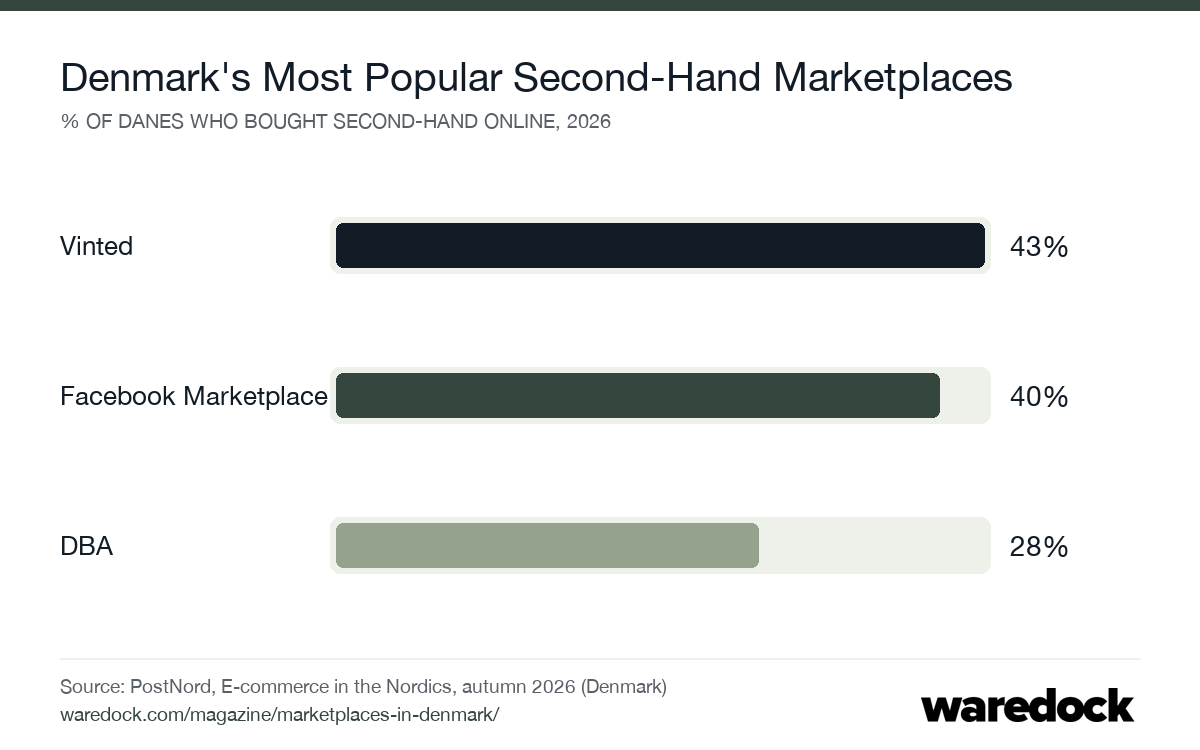
Denmark’s second-hand market is driven more by buying than selling, and consumer-to-consumer trading dominates. Vinted is now the most popular second-hand marketplace (43% of second-hand buyers), especially with younger shoppers, after buying the Danish fashion resale site Trendsales in 2024 and moving its users over. Facebook Marketplace (40%) and DBA (Den Blå Avis) (28%), owned by Vend (formerly Schibsted Marketplaces), appeal more to older consumers. The biggest barriers to selling are fraud or payment worries (21%), “not worth the effort” (15%) and difficulty describing and pricing items (12%) (PostNord, autumn 2026).
Source: PostNord, E-commerce in the Nordics, autumn 2026.
For brands, these platforms are where your products get a second life, and an argument for offering take-back or resale yourself. DBA also suits clearing returns and bulky outlet stock locally.
Denmark’s biggest webshops are mostly retailers
Similarweb’s ranking of Denmark’s most visited “marketplace” websites in October 2026 shows how retailer-led the market is. Apart from Amazon.de, the top five are Danish chains that mostly sell their own stock:
| Rank (Oct 2026) | Website | What it is |
|---|---|---|
| 1 | jemogfix.dk | Jem & Fix, DIY and garden chain |
| 2 | amazon.de | Amazon’s German store, with Danish language |
| 3 | silvan.dk | Silvan, DIY and building chain |
| 4 | magasin.dk | Magasin, department store |
| 5 | thansen.dk | Thansen, car parts and tools |
Other leaders named by Mordor Intelligence include Bilka (Salling Group), Harald Nyborg, Elgiganten and Apple. Salling Group announced in July 2026 that it will connect Bilka and its other stores to Google’s Gemini AI. To sell through these retailers, you usually become a supplier: pitch the buyer, agree wholesale terms and deliver to their warehouses. See B2B and retail fulfilment.
Who should sell where in Denmark?
| Your business | Start with | Add next |
|---|---|---|
| Fashion, shoes and sportswear brand | Zalando | Miinto, your own Danish webshop |
| Already selling on Amazon in Europe | Amazon.de | CDON for the Nordics |
| Electronics and accessories | Elgiganten Marketplace | CDON, Amazon.de |
| Multi-category Nordic seller | CDON | Fyndiq (same group) |
| Value ranges and excess stock | Fyndiq | DBA for outlet and bulky stock |
| Pre-owned fashion and resale | Vinted | Miinto (via The Vintage Bar for luxury) |
| Supplier to Danish retail chains | Wholesale to Salling Group, Elgiganten or DIY chains | Marketplaces for direct-to-consumer sales |
What Danish buyers expect
- MobilePay at checkout. MobilePay has more than 4.3 million Danish users (U.S. Commercial Service), and 47% of Danes pay with an app while 52% prefer to (Dansk Erhverv). On your own webshop, offer MobilePay next to cards.
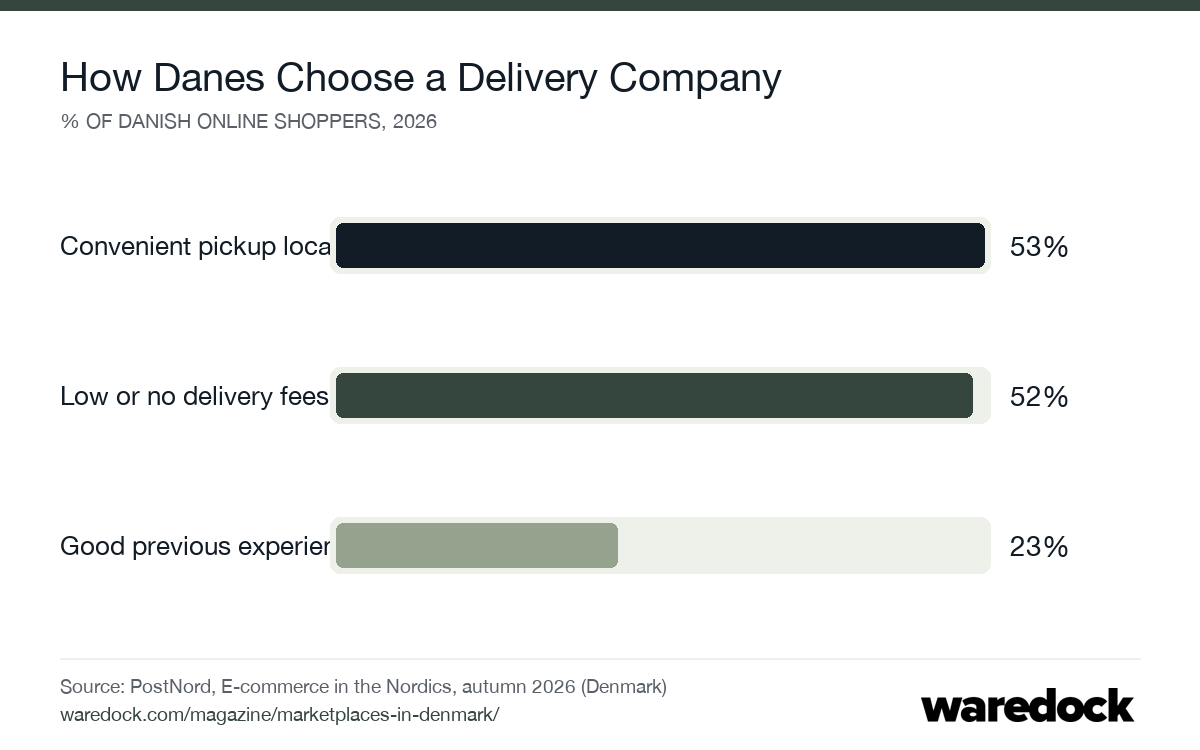
- Pickup points and low delivery fees. When choosing a delivery company, Danes put convenient pickup locations (53%) and low or no fees (52%) far ahead of anything else. Free delivery is still the improvement shoppers ask for most.
- Clear delivery information. Your preferred payment method and clear delivery details are the top factors for a smooth checkout. In the countryside, 47% name delivery information as a top factor, against 34% in big cities.
- A simple checkout. 84% were satisfied with checkout on their latest purchase. Younger shoppers are least satisfied (79% of 18–29-year-olds), and more people now want to check out without creating an account (PostNord, autumn 2026).
- Danish content and prices in DKK. Denmark uses the krone, and listings in Danish convert better than English ones.
Source: PostNord, E-commerce in the Nordics, autumn 2026. Source: PostNord, E-commerce in the Nordics, autumn 2026. 62% of Danes used AI when shopping for physical products in the past three months.
VAT and rules: Denmark’s VAT rate is 25%. If your stock is in another EU country, B2C sales to Denmark can usually be reported through the EU One-Stop Shop (OSS) once you pass the €10,000 EU-wide distance-selling threshold; storing stock in Denmark generally means registering for Danish VAT. Greenland and the Faroe Islands are outside the EU VAT area, so orders there need customs handling. See our guide to EU VAT, OSS and IOSS, and check your case with a tax adviser.
How to ship marketplace orders to Denmark

Most Danish marketplaces leave delivery to you, and Danish buyers judge you on pickup points, delivery fees and clear delivery times. Your options:
- Ship from Germany: Denmark is one border away, so a German warehouse reaches Danish homes and pickup points by road, and the same stock serves Germany, Benelux, Austria and Poland.
- Warehouse in Denmark: fastest local delivery, but high labour and storage costs and a Danish VAT registration.
- Nordic split: if you also sell in Sweden and Finland, a second stock point in Estonia covers those markets, while Germany covers Denmark.
How Waredock helps: we ship Danish orders by road from our warehouse network in Germany, with tracked parcel and pallet services, and run your webshop, Amazon FBM and Nordic marketplace orders from the same stock. For Sweden, Finland and the Baltics we fulfil from our warehouse in Estonia. Our team and AI agents work together on every order, so it ships fast and right first time. See fulfilment in Germany, fulfilment for marketplace sellers and fulfilment companies in the Nordics and Baltics compared.
Selling across the region? See top marketplaces in Sweden, top marketplaces in Finland and our top 30 marketplaces in Europe.
Frequently asked questions
What is the biggest online marketplace in Denmark?
For new goods, Zalando leads in fashion and Amazon.de is the most visited international marketplace, though Denmark has no Amazon store of its own. CDON, Fyndiq and Elgiganten Marketplace are the main Nordic marketplaces. For second-hand, Vinted is the most popular, ahead of Facebook Marketplace and DBA.
Is there an Amazon Denmark (amazon.dk)?
No. Danish shoppers use Amazon.de, which has offered a Danish-language version since November 2023. Sellers reach them through a European Amazon seller account.
Which marketplace is best for selling fashion in Denmark?
Zalando, with a localised Danish store. Miinto, founded in Copenhagen, suits premium brands and boutiques, and Vinted leads pre-owned fashion.
Why do Danes shop abroad so much?
For a wider selection, lower prices and products not sold in Denmark. 86% bought from a foreign webshop in the past year, the highest share in the Nordics, with Germany and Sweden now the most common origins.
Can I reach all the Nordic countries with one account?
Yes. CDON and Fyndiq each cover Denmark, Sweden, Finland and Norway from one seller account. Norway is outside the EU, so it needs VOEC registration and customs.
How do Danes prefer to pay online?
Cards and MobilePay are the most common. MobilePay has more than 4.3 million Danish users, and about half of Danes prefer to pay with an app.
Method: marketplace facts and fees come from each company’s own website, reports or official integration partners, checked November 2026. Market data comes from the sources below. This guide doesn’t rank marketplaces by quality; the order reflects relevance for brands selling new goods to Danish consumers.
Sources
- Dansk Erhverv – E-handelsanalysen 2025: 5 things to know (18 February 2026)
- Dansk Erhverv – Danish eCommerce has not peaked (February 2026)
- Dansk Erhverv – Amazon launches Danish in its German store (16 November 2023)
- Dansk Industri – Danes’ annual eCommerce tracker 2025
- PostNord – E-commerce in the Nordics, autumn 2026 (report and Denmark chapter)
- U.S. Commercial Service – Denmark Country Commercial Guide: eCommerce (May 2026)
- Mordor Intelligence – Denmark E-commerce Market (2026)
- Similarweb – Top marketplace websites in Denmark (October 2026)
- Zalando SE – Annual Report 2025
- Investing.com – CDON Q2 2026 presentation
- e-tailize – Selling on Fyndiq (fees), checked November 2026
- Mirakl – Marketplace and dropship in the Nordic region
- Dansk Online Tidende – Miinto grows sales 86%
- Just Style – Miinto buys The Vintage Bar
- FashionUnited – Vinted acquires Trendsales (March 2024)
- Vend – Schibsted Marketplaces becomes Vend (2025)
- OnBuy – Nordic expansion with Posten Bring investment (25 June 2026)
- Wikipedia – MobilePay, Den Blå Avis, Vinted, CDON, Salling Group
- Skattestyrelsen – VAT
- Cover photo: The Great Belt Bridge by Martin Falbisoner, CC BY-SA 4.0, via Wikimedia Commons