
What is a barcode?
A barcode is a machine-readable pattern of bars, or squares in a 2D code, that represents a number or text. A scanner reads the pattern and turns it into the number, which a system then looks up: the product, its price, its stock level or its shipment. Barcodes are on almost every product, carton, pallet and parcel, and they make checkout, warehousing and shipping fast and accurate.
The first product scanned at a supermarket checkout with a barcode was a pack of chewing gum in Ohio in 1974. Today, the global standards for product barcodes are managed by GS1, a non-profit organisation with member offices in more than 100 countries.
Core principle: The barcode is just the picture. What matters is the number behind it, and that number must be unique for each product, carton or pallet.
How a barcode works
1. A number is assigned
For products, this is usually a GTIN (Global Trade Item Number), licensed through GS1 to the brand owner.
2. The number is encoded
The number is turned into a pattern of bars and spaces of different widths, or a grid of squares, and printed on the packaging or a label.
3. A scanner reads it
Laser scanners read 1D barcodes; camera-based scanners and smartphones also read 2D codes. The scanner sends the number to the till, the warehouse system or the carrier’s system.
4. The system looks it up
The number links to the product data: name, price, stock, batch or shipment. The barcode itself doesn’t contain the price.
Types of barcodes
| Barcode | Type | Where you see it |
|---|---|---|
| EAN-13 (GTIN-13) | 1D | Consumer products in Europe and most of the world |
| UPC-A (GTIN-12) | 1D | Consumer products in the US and Canada |
| EAN-8 | 1D | Very small packs |
| ITF-14 (GTIN-14) | 1D | Outer cartons with several units |
| GS1-128 / SSCC | 1D | Pallet and shipping labels for retailers |
| Code 128 | 1D | Internal labels, locations and many carrier labels |
| QR code | 2D | Websites, product information, returns and payments |
| Data Matrix | 2D | Small items, medicines, electronics, parcel labels |
1D vs 2D: a 1D barcode stores a short number in one row of bars. A 2D code stores much more data, such as a batch number, expiry date or web link, in a small square. Under GS1’s “Sunrise 2027” plan, retail checkouts should be able to read 2D codes by the end of 2027, alongside the classic EAN and UPC barcodes, which are not being phased out.
EAN, UPC and GTIN explained
GTIN is the number; EAN and UPC are the barcode formats that carry it. A product sold in Europe usually has a 13-digit GTIN printed as an EAN-13 barcode. Each product variant, such as each size and colour, needs its own GTIN. The product’s SKU is different: an internal code you choose yourself, which isn’t unique outside your business.
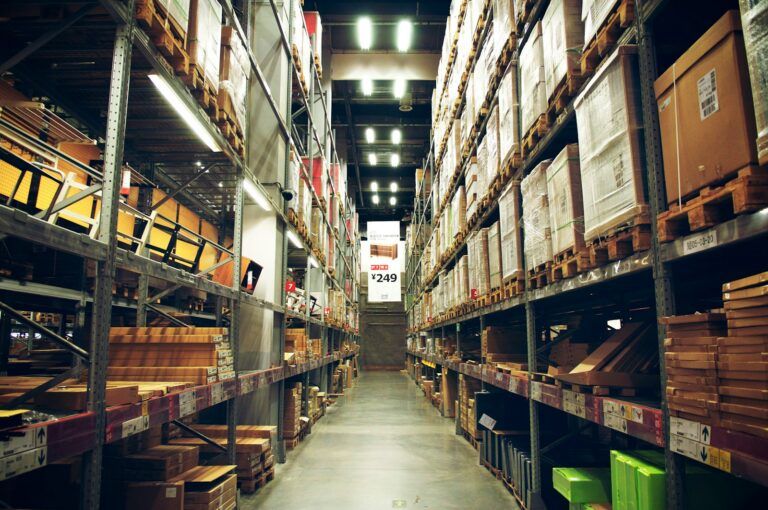
Barcodes in the warehouse and in shipping
- Receiving: products and cartons are scanned on arrival, so stock is booked correctly. See receiving dock.
- Storage: every shelf and pallet location has its own barcode, so the WMS knows exactly where stock is.
- Picking and packing: pickers scan the location and the product, which prevents wrong items in the box. See pick and pack.
- Pallets for retailers: large retailers require an SSCC label on each pallet, linked to an advance shipping notice.
- Parcels: carrier labels carry a tracking barcode that is scanned at every step. See track and trace.
- Amazon: Amazon uses its own FNSKU label for FBA stock, in addition to or instead of the manufacturer barcode. See FBA prep.
Example: A skincare brand launches 12 products in three sizes: 36 variants. It licenses GTINs from its national GS1 office, prints an EAN-13 barcode on each pack, and sends a product list with SKUs and GTINs to its fulfilment warehouse. When the stock arrives, every carton is scanned against the list, and any product without a barcode is labelled before it goes on the shelf.
How to get barcodes for your products
- Join GS1 in your country and license a company prefix. The fee depends on how many numbers you need.
- Assign one GTIN to each product variant and keep a list with your SKUs.
- Print the EAN-13 barcode on the packaging, at the right size and with enough contrast.
- Share the GTINs with your marketplaces, retailers and fulfilment warehouse.
Watch out for: cheap barcodes resold online may not be registered to your company. Amazon and many retailers check GTINs against the GS1 database and can reject listings with numbers that belong to someone else.
Frequently asked questions
What is a barcode?
A machine-readable code of bars or squares that stores a number, such as a product’s GTIN, so it can be scanned quickly and accurately.
What is the difference between EAN and UPC?
Both carry a product’s GTIN. EAN-13 has 13 digits and is used in Europe and most countries; UPC-A has 12 digits and is used in the US and Canada. Modern scanners read both.
Does a barcode contain the price?
No. It contains a number. The price is stored in the shop’s system and linked to that number.
Do I need a barcode to sell on Amazon?
Usually yes: Amazon asks for a GTIN such as an EAN or UPC, unless your brand qualifies for an exemption. For FBA, products also need an FNSKU label or an eligible manufacturer barcode.
Is a QR code a barcode?
Yes, a 2D barcode. It can store much more data than a classic 1D barcode, including web links.